
 EN
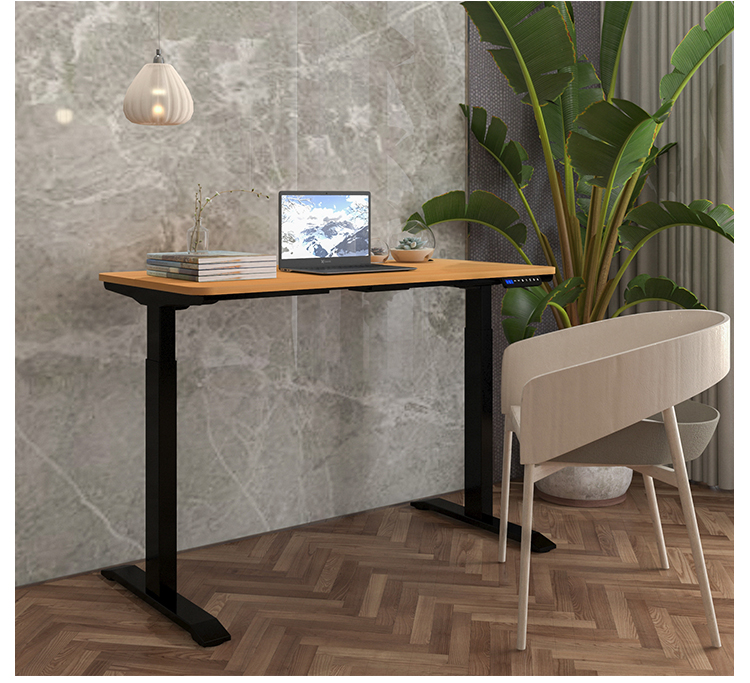
Security operations centers (SOCs), air-traffic and rail dispatch floors, financial trading desks, and industrial CAD engineering departments run mission-critical hardware twenty-four hours a day. Placing quad-screen VESA arrays, dual-processor workstation towers, and rack-grade UPS battery units onto ordinary office tables invites frame sag and catastrophic hardware drops—making a purpose-built heavy duty computer office desk essential infrastructure.
Mechanical Stress Risks in Multi-Monitor Technical Workstations
Modern technical workstations concentrate far higher rotational torque and static mass onto narrower footprints than traditional paper-based office desks ever encountered.
Rotational Rear-Edge Torque From Cantilevered Screen Arrays
Four 27-inch monitors mounted onto a single articulated steel pole exert intense forward lever-arm torque right at the rear clamping collar. Thin sheet-metal lips or composite wood cores deform gradually over weeks, causing heavy screen arrays to lean forward, bind gas-spring joints, or tear free from the rear edge.
UPS Battery Weight Overloading Light Pedestal Floors and Crossbeams
Uninterruptible power supply (UPS) lead-acid or lithium battery bricks weigh fifteen to thirty kilograms each. Resting UPS units inside thin-bottomed desk compartments or across unbraced lower shelves bows sheet metal downward until compartment doors jam shut.
Five Structural Advantages Engineered Into Heavy Duty Computer Desks
A commercial heavy duty computer office desk counters concentrated IT loads through five targeted sheet-metal and frame reinforcements.
|
Structural Advantage |
Heavy Duty Engineering Design |
Mission-Critical IT Benefit |
|
Box-Channel Rear Clamp Rail |
1.0–1.2 mm folded steel rear beam + backing gusset |
Zero flex under quad-monitor VESA pole torque |
|
Multi-Ribbed Steel Worktop |
Closely spaced welded hat-section underside channels |
Eliminates vibration transfer from desktop towers to screens |
|
Reinforced UPS & CPU Deck |
Heavy-gauge slotted steel base shelf + welded support ribs |
Carries dense UPS battery bricks and dual-GPU workstations |
|
Rigid Gusseted Leg Columns |
Closed rectangular steel tubes + bolted steel cross-aprons |
Stops lateral screen sway during multi-shift operations |
|
High-Capacity Cable Spine |
Structural steel rear trough acting as secondary torsion beam |
Houses thick power harnesses while stiffening the span |
1. Torque-Resistant Rear Box Beams for Multi-Screen Mounts
Instead of a single-bent sheet lip, heavy duty computer desks form heavy-gauge cold-rolled SPCC steel into a closed rectangular perimeter channel along the rear edge—and weld thick steel reinforcing plates directly beneath pre-punched grommet clamp zones to absorb cantilevered monitor torque effortlessly.
2. High-Frequency Vibration Damping Across Ribbed Desktops
Spinning hard drives, high-RPM workstation fans, and rapid mechanical keyboard typing generate micro-vibrations that blur fine CAD lines on shaky tables. Closely spaced welded omega stiffener ribs paired with elastomeric damping strips create a dead-solid, vibration-free surface plane.
3. Heavy-Load Suspended Decks for UPS Units and Workstation Towers
Dedicated under-desk equipment cradles built from 1.0 mm to 1.2 mm cold-rolled steel with folded lip flanges support heavy UPS battery backups and tower workstations off dusty floors—allowing janitorial crews to sweep underneath cleanly without unplugging critical backup power.
4. Triangulated Portal Subframes Built for 24/7 Shift Rotations
In three-shift control rooms, operators constantly push off desk edges when rolling chairs between adjacent terminals. Gusseted corner joints uniting thick-wall vertical columns with deep steel modesty beams eliminate cumulative fastener loosening and lateral racking.
5. Dual-Role Structural Cable Bays and Durable Powder Finishes
Deep cold-rolled steel cable troughs bolted between left and right leg columns carry heavy PDU power bars while doubling as a rigid structural spine. Founded in 1992, Luoyang Huawei Office Furniture Co., Ltd. passed the first third-party factory inspection and pioneered mail-order packing in the Luoyang office furniture industry—fabricating heavy-duty steel computer desks and custom OEM control-room frames backed by veteran sheet-metal engineers.
Technical and Facility Compliance Standards for IT Operations
Enterprise infrastructure managers specify heavy duty computer workstations around verifiable international codes:
- ANSI/BIFMA X5.5: Validates concentrated perimeter proof loads (critical for heavy edge-clamped monitor arrays) alongside distributed surface load and leg side-thrust durability.
- NFPA 70 / NFPA 75 (IT Equipment Protection): Non-combustible powder-coated steel enclosures minimize fire propagation risks around high-density power strips and battery backup units.
- OSHA 1910 Ergonomic & Electrical Cord Standards: Smooth rolled grommet edges prevent AC insulation cuts, while unobstructed knee envelopes keep operators comfortable across twelve-hour shifts.
- ISO 9227 & ASTM D3359: Confirms corrosion-proof finish adhesion inside positive-pressure, heavily cooled technical rooms.
Practical Deployment, Load Distribution, and Maintenance Advice
Thoughtful hardware placement and periodic mechanical checks protect expensive IT gear over multi-year refresh cycles.
Balancing Heavy Tower and Monitor Loads During IT Setup
Mount multi-screen VESA poles directly through reinforced grommet plates or immediately adjacent to vertical leg gussets rather than unsupported mid-spans, and place heavy UPS battery units in lower suspended steel cradles to keep the workstation’s center of gravity low.
Routine Preventive Checks During IT Hardware Refreshes
Whenever corporate IT swaps desktop PCs or monitors every three years, have technicians check M8 frame crossbeam bolts with a torque wrench, vacuum dust bunnies from ventilated CPU cradles, and inspect rubber grommet liners for snug seating.
Frequently Asked Questions
How much monitor weight can a heavy duty steel computer desk rear edge support?
When engineered with a 1.0 mm to 1.2 mm cold-rolled steel desktop reinforced by a triple-folded rear box flange and welded underside backing plates per ANSI/BIFMA X5.5 concentrated load criteria, the rear mounting zone easily supports heavy commercial dual-, triple-, or quad-monitor VESA pole assemblies without bending.
Why mount UPS battery units in suspended steel cradles instead of on the floor?
Keeping heavy UPS battery backups and tower PCs elevated inside ventilated under-desk steel cradles protects intake fans from carpet dust, prevents mop water or floor-scrubber bumps from triggering power outages, and lets cables move cleanly whenever a desk is slid forward for wall-jack servicing.
How do heavy duty steel computer desks manage heat from multiple power bricks?
Enclosed steel cable troughs on heavy duty IT desks feature CNC-punched ventilation slots along the bottom and rear walls, allowing convective heat from multiple laptop chargers, docking bricks, and PoE adapters to dissipate upward freely rather than baking inside a sealed box.
Are matte charcoal or light grey finishes better for multi-monitor rooms?
In dimly lit security command rooms, video editing bays, or trading floors, low-gloss matte charcoal or dark slate powder coatings minimize peripheral light bounce off the desktop surface, boosting perceived screen contrast and reducing operator eye fatigue across long shifts.
Can OEM factories pre-punch custom cutout sizes for Pop-Up desk power modules?
Yes. Buyers supplying the exact dimensional cutout template for UL-listed, CE-listed, or regional recessed desktop power/USB/RJ45 modules can have the factory laser-cut sub-millimeter rectangular mounting apertures directly into the steel top prior to chemical pre-treatment and powder coating.
How are heavy duty computer desks packed to avoid bent CPU bays in shipping?
Knock-down design breaks the workstation into flat structural panels—stacking the desktop, leg frames, ventilated CPU bay panels, and cable trough flat with high-density honeycomb spacers and corner armor inside 5-ply mail-order cartons tested against multi-angle transit drops.
Table of Contents
- Mechanical Stress Risks in Multi-Monitor Technical Workstations
-
Five Structural Advantages Engineered Into Heavy Duty Computer Desks
- 1. Torque-Resistant Rear Box Beams for Multi-Screen Mounts
- 2. High-Frequency Vibration Damping Across Ribbed Desktops
- 3. Heavy-Load Suspended Decks for UPS Units and Workstation Towers
- 4. Triangulated Portal Subframes Built for 24/7 Shift Rotations
- 5. Dual-Role Structural Cable Bays and Durable Powder Finishes
- Technical and Facility Compliance Standards for IT Operations
- Practical Deployment, Load Distribution, and Maintenance Advice