
 EN
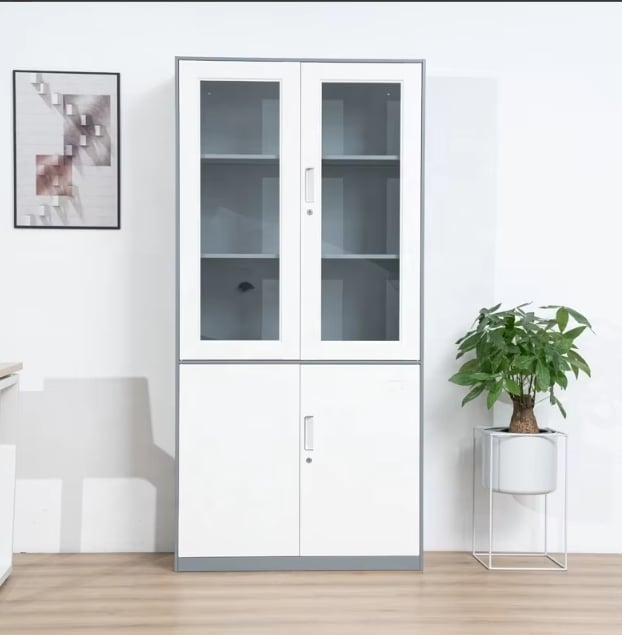
Archive vaults holding decades of bound tax ledgers, hospital central supply rooms storing surgical kits, engineering departments locking precision calibration fixtures, and government records offices quickly crush thin-gauge retail storage cupboards. Commissioning a heavy duty custom office cabinet engineered from thick cold-rolled SPCC steel provides tailored interior organization alongside industrial-grade load and security performance.
Structural Risks of Using Light-Duty Cupboards for Dense Archives
Forcing standard 0.5 mm sheet-metal retail cupboards to hold high-density commercial payloads creates cascading mechanical and workplace safety failures.
Pilaster Tab Shear and Cascading Shelf Collapse
Thin stamped shelf clips hooked into shallow single-wall sheet slots deform downward when shelves carry dense lever-arch binders, paper reams, or metal equipment cases. If one upper corner clip shears free under shock loading, the falling shelf impacts the shelf below—triggering a dangerous cascading collapse inside the cabinet.
Frame Racking That Defeats Single-Point Cam Locks
When a tall, thin-walled cabinet sits on slightly uneven flooring under heavy internal weight, the rectangular box racks into a parallelogram. Single-point center cam latches lose overlap with the strike plate, allowing doors to pop open when bumped or jam shut so keys snap off inside the cylinder.
Five Structural Advantages of a Heavy Duty Custom Office Cabinet
Specifying a bespoke heavy duty steel cabinet unlocks five critical structural upgrades tailored directly to demanding commercial payloads.
|
Structural Advantage |
Heavy Duty Custom Engineering |
High-Load Facility Payoff |
|
Box-Column Corner Uprights |
0.8–1.2 mm multi-fold SPCC corner posts + base gussets |
Prevents tall cabinet racking under 300+ kg total payloads |
|
Dual-Ribbed Box Shelves |
Triple-bent flanges + welded twin underside omega channels |
Carries 60–100+ kg per shelf with zero center droop |
|
Reinforced Pilaster Strips |
Separate welded box-channel vertical standards + wide clips |
Eliminates shelf-tab shear and offers fine height tuning |
|
3-Point Rod Locking |
Center cam + top/bottom vertical steel shoot bolts |
Secures tall doors tightly top-to-bottom against prying |
|
Sealed Anti-Rust Armor |
9-stage conversion pre-treatment + 60–80 um powder coat |
Protects basement archives and coastal clinics from rust |
1. Multi-Folded Structural Corner Posts and Gusseted Plinth Bases
Instead of relying on thin single-bent side sheets to carry vertical weight, heavy duty custom cabinets form cold-rolled steel into rigid multi-bend hollow corner columns tied into a reinforced bottom U-channel base frame fitted with heavy threaded steel leveling feet—keeping tall enclosures dead-square under full load.
2. Twin-Ribbed Shelves Engineered for Exact Payload Ratings
Because OEM engineers calculate exact bending moments for the buyer’s specified width and weight target, shelves combine heavier SPCC steel gauges with twin full-length welded underside hat-section stiffeners—supporting dense rows of legal binders, medical fluids, or tooling without sagging.
3. Welded Vertical Box Pilasters With Positive-Locking Clips
Rather than punching slots straight through thin outer side walls, heavy duty custom cabinets spot-weld dedicated vertical box-section steel pilaster strips inside all four corners. Heavy stamped galvanized or powder-coated steel support brackets engage dual slots simultaneously for rock-solid shear strength.
4. Three-Point Vertical Shoot-Bolt Locking and Full Piano/Pin Hinges
Tall heavy duty swing doors pivot on reinforced concealed steel pin hinges or full-height stainless piano hinges while securing via a three-point steel rod linkage: turning the handle drives solid steel bolts into both the upper header and lower threshold simultaneously alongside the center cam latch.
5. Complete Chemical Passivation and Drop-Tested Packaging
Every shelf rib, pilaster cavity, and door hem undergoes full chemical degreasing and conversion coating prior to electrostatic epoxy-polyester curing. Founded in 1992, Luoyang Huawei Office Furniture Co., Ltd. passed the first third-party factory inspection and introduced dedicated mail-order packing in the Luoyang office furniture industry—building heavy-duty custom steel cabinets and lockers engineered from customer drawings or samples.
Authoritative Safety and Storage Compliance Benchmarks
Institutional facility managers validate heavy duty custom cabinets against established regulatory standards:
- ANSI/BIFMA X5.9: Confirms shelf distributed proof-load survival without permanent deflection, 3-point door latch cyclic durability, and fully loaded stability.
- OSHA 1910.176 (Materials Handling & Storage) & Seismic Anchoring: Requires storage cabinets to stack and hold materials securely without sliding, collapsing, or tipping—supported by factory-punched rear wall-anchor gussets and hemmed burr-free shelf lips.
- NFPA 101 & NFPA 30 Awareness: Non-combustible steel cabinets reduce general corridor and record-room fire loads (while dedicated double-wall NFPA 30 cabinets are specified separately if storing flammable liquids).
- ISO 9227 & ASTM D3359: Validates humid-vault corrosion immunity and cross-hatch paint adhesion.
Practical Load Management, Anchoring, and Maintenance Tips
Following smart installation and loading discipline guarantees decades of safe high-density storage.
Bottom-Heavy Loading and Wall-Stud Tie-Back Rules
Always anchor tall heavy duty cabinets (>1200 mm high) into structural masonry or wall studs using the pre-punched upper rear mounting points, level bottom steel glides before loading shelves, and store the heaviest paper reams or equipment cases on the lowest two tiers to keep center of gravity low.
Annual Three-Point Linkage and Hinge Inspection
Once a year in high-traffic supply rooms, verify upper and lower shoot-bolt nylon guide bushings remain seated smoothly inside door hems, check shelf-clip seating across all four corners of each shelf, and wipe powder-coated interiors with a dry or damp microfiber cloth.
Frequently Asked Questions
How much weight can each shelf hold in a heavy duty custom steel office cabinet?
While standard light-office cabinet shelves hold roughly 30 to 40 kg, heavy duty custom steel shelves fabricated from 0.8 mm to 1.2 mm cold-rolled SPCC steel with triple-bent lips and twin welded underside omega stiffeners routinely support 60 kg to over 100 kg of evenly distributed archival or industrial weight per shelf.
Why is a 3-point locking rod system superior on tall steel cabinets?
On cabinets standing 1800 mm to 2100 mm tall, a single center cam lock leaves upper and lower door corners flexible enough for a pry tool to bend open. A 3-point steel rod mechanism locks the top header, center strike, and bottom threshold simultaneously, holding doors flush and pry-resistant.
Can heavy duty custom cabinets be built in knock-down format without losing strength?
Yes. Heavy-gauge knock-down cabinets utilize precision CNC interlocking box-corner joints reinforced with internal M6/M8 machine bolts and gusseted base frames. Once assembled and leveled on-site, structural vertical load capacity matches welded cabinets while slashing ocean freight volume by over seventy percent.
What hinge styles prevent door sag on wide heavy duty custom cabinets?
For extra-wide or frequently opened heavy duty steel doors, OEM engineers upgrade standard two-point pivot pins to three-point heavy-duty concealed barrel hinges, commercial 180-degree external knuckle hinges, or full-length continuous piano hinges that distribute door weight evenly along the vertical jamb.
Are perforated ventilated doors available on heavy duty custom office cabinets?
Yes. CNC turret punches produce clean diamond, circular, or louvered ventilation arrays across steel cabinet doors—ideal for IT charging cabinets storing laptops/tablets with internal power strips, industrial PPE drying cabinets, or visual-inventory supply lockers requiring airflow without sacrificing lock security.
How should basement archive rooms protect steel cabinets from concrete slab dampness?
Order heavy duty custom cabinets equipped with an elevated 80 mm to 100 mm galvanized or powder-coated steel plinth base fitted with stainless or nylon-bottomed adjustable leveling glides, keeping bottom cabinet seams elevated well above damp basement concrete and allowing airflow underneath.
Table of Contents
- Structural Risks of Using Light-Duty Cupboards for Dense Archives
-
Five Structural Advantages of a Heavy Duty Custom Office Cabinet
- 1. Multi-Folded Structural Corner Posts and Gusseted Plinth Bases
- 2. Twin-Ribbed Shelves Engineered for Exact Payload Ratings
- 3. Welded Vertical Box Pilasters With Positive-Locking Clips
- 4. Three-Point Vertical Shoot-Bolt Locking and Full Piano/Pin Hinges
- 5. Complete Chemical Passivation and Drop-Tested Packaging
- Authoritative Safety and Storage Compliance Benchmarks
- Practical Load Management, Anchoring, and Maintenance Tips