
 EN
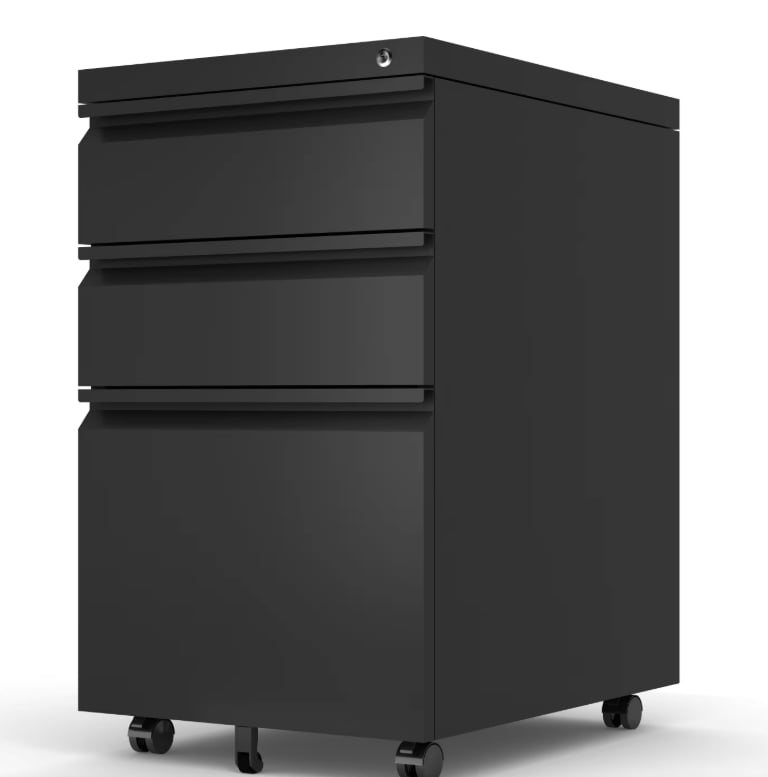
Standard 900 × 400 × 1850 mm catalog filing cabinets frequently leave awkward architectural gaps inside recessed wall alcoves, hospital pharmacy bays, laboratory instrument rooms, judicial evidence vaults, and private-label e-commerce product lines. Commissioning a custom office cabinet project through an experienced sheet-metal OEM manufacturer turns bespoke storage requirements into precision-engineered, flat-pack steel cabinets without prohibitive tooling delays.
Costly Failure Modes in Poorly Engineered Custom Cabinet Runs
Ordering non-standard steel cabinets from workshops lacking parametric 3D sheet-metal CAD software and automated CNC bending brakes creates severe structural and installation headaches.
Bowed Wide Shelves and Misaligned Door Gaps
Stretching a standard 900 mm cabinet width out to 1200 mm without recalculating shelf flange depth and underside rib stiffness causes loaded shelves to sag into deep U-curves within days. Simultaneously, slight diagonal frame twist makes tall swing doors overlap at the top while gaping open at the bottom latch.
Unprotected Knock-Down Panels Rubbing Raw in Transit
Custom cabinet dimensions cannot squeeze safely into off-the-shelf stock cardboard boxes. Workshops that improvise oversized cartons by taping two boxes together ship flat-pack doors that shift, scuff powder coatings down to bare metal, and suffer crushed interlocking corner tabs during container transit.
Inside the End-to-End OEM Steel Cabinet Engineering Workflow
Capable steel storage manufacturers execute custom office cabinet projects through five disciplined design-for-manufacturing (DFM) stages.
|
OEM Engineering Stage |
Technical Execution Detail |
Project & Brand Buyer Benefit |
|
1. 3D Sheet-Metal CAD |
Parametric bend-allowance (K-factor) & knock-down modeling |
Guarantees tight door seams and tool-free tab alignment |
|
2. CNC Laser & Turret |
Mold-free cutting of custom louvers, lock slots, & pilasters |
Rapid 7-to-10-day physical prototypes with zero hard-die cost |
|
3. Load-Tuned Ribbing |
Custom underside omega stiffeners matched to shelf span |
Prevents sag under dense A4 binders, media, or lab kits |
|
4. Lock & Door Tailoring |
Swing, tambour, sliding glass, or RFID/digital cam locks |
Exact functional match for clinic, office, or retail workflows |
|
5. Custom Mail-Order Pack |
Dedicated 5-ply carton + custom honeycomb/EPS shock layout |
Safe palletized project delivery or single-box parcel shipping |
Parametric Knock-Down Engineering for Effortless Field Assembly
Translating custom external height, width, and depth specs into a knock-down flat-pack steel cabinet requires sub-millimeter K-factor bend compensation. Experienced CAD engineers design snap-in dovetail corner slots and concealed internal bolt flanges so field crews assemble rigid, plumb cabinets in minutes using minimal fasteners.
Tailoring Door Mechanics, Glass Inserts, and Locking Hierarchies
OEM customization extends far beyond external box size: buyers specify space-saving ball-bearing sliding doors for narrow corridors, tempered safety-glass upper display doors per ANSI Z97.1 / EN 12150, perforated acoustic doors, three-point vertical rod latches, digital keypad locks, or master-keyed cylinder groups.
Leveraging Three Decades of Audited Luoyang Cabinet Expertise
Selecting an established steel cabinet specialist eliminates prototyping trial-and-error. Founded in 1992, Luoyang Huawei Office Furniture Co., Ltd. became the first factory in the Luoyang office furniture industry both to pass independent third-party factory inspection and to pioneer mail-order packing—combining an experienced OEM design team and skilled workers to build custom steel file cabinets, lockers, and office furniture directly from buyer plans or physical samples.
Compliance Standards Governing Custom Commercial Cabinets
Custom architectural and institutional storage projects must satisfy strict structural and safety benchmarks:
- ANSI/BIFMA X5.9 (Storage Units): Validates shelf distributed load deflection limits, door hinge/slide cycle endurance, lock latch strength, and freestanding anti-tip stability.
- OSHA 1910 & Seismic Wall-Anchoring Readiness: Pre-punched rear structural wall-tie keyholes allow tall custom cabinets (>1500 mm) to bolt securely into wall studs in seismic or high-traffic zones, paired with burr-free hemmed shelf edges.
- NFPA 101 & Zero-VOC Finishes: Non-combustible cold-rolled steel cabinets reduce corridor and archive-room fire loads while emitting zero formaldehyde indoors.
- ISO 9001, ISO 2409 & ISO 9227: Ensures batch-to-batch part interchangeability and corrosion-proof powder adhesion.
Practical RFQ Preparation, Prototype Sign-Off, and Upkeep Tips
Providing complete operational context in the initial technical brief speeds quoting and prevents mid-project revisions.
Key Parameters to Specify in a Custom Cabinet RFQ
Include exact external alcove limits (W × D × H), per-shelf target kilogram load (for example, 40 kg standard folders vs. 80 kg dense archival boxes), adjustable pilaster pitch increments, door swing or slide preference, lock type, target RAL/Pantone color and texture, and whether cartons ship palletized or via individual parcel couriers.
Golden Sample Load-Testing and Long-Term Hinge Care
Test-load one full shelf on the approved prototype for 24 hours with calibrated weights to verify zero permanent set before releasing mass production. In daily facility use, anchor tall cabinets flush to level walls, place heaviest items on bottom shelves, and check three-point latch rods annually.
Frequently Asked Questions
What minimum information is needed to quote a custom steel office cabinet?
Buyers simply share target external dimensions, internal shelf or drawer layout sketches, required shelf load capacity, lock preference, RAL color code, and estimated order quantity. An in-house factory CAD team then prepares detailed 2D/3D approval shop drawings showing exact cold-rolled steel gauges before cutting a physical sample.
Do custom-sized steel office cabinets require expensive stamping molds?
Rarely. Modern sheet-metal factories utilize high-speed fiber laser cutters, programmable CNC turret punch presses, and multi-axis CNC press brakes to fabricate custom panel heights, shelf widths, louver patterns, and lock apertures directly from digital CAD files—avoiding five-figure hard stamping die investments.
How do engineers reinforce wide custom cabinet shelves against sagging?
When custom cabinet widths extend to 1000 mm, 1200 mm, or wider, engineers upgrade shelf bare-metal gauge from 0.6 mm to 0.8–1.0 mm SPCC steel, form triple-bent box channels along front and rear lips, and spot-weld one or two full-length hat-section stiffener ribs underneath.
Can custom steel cabinets combine drawers on the bottom and doors on top?
Yes. Hybrid combo cabinets—such as two lateral full-extension hanging-file drawers on the lower half paired with lockable steel or tempered-glass swing doors above, or half-wardrobe locker plus half-shelf layouts—are among the most popular OEM configurations for medical, legal, and executive offices.
How are tall custom steel cabinets shipped without taking huge container space?
Knock-down (KD) flat-pack engineering folds side panels, back walls, doors, and shelves into a single compact master carton roughly 100 mm to 140 mm thick—allowing 300 to 500+ tall cabinets to load inside one 40HQ ocean container compared to fewer than 90 pre-welded units.
What glass specification is safest for custom display office cabinets?
Always specify automotive/architectural-grade 4 mm or 5 mm tempered safety glass (certified to ANSI Z97.1 or EN 12150) seated inside full-perimeter rubber shock gaskets and retained by bolted steel clips—ensuring high impact resistance and safe granular crumbling rather than sharp shards if ever broken.