
 EN
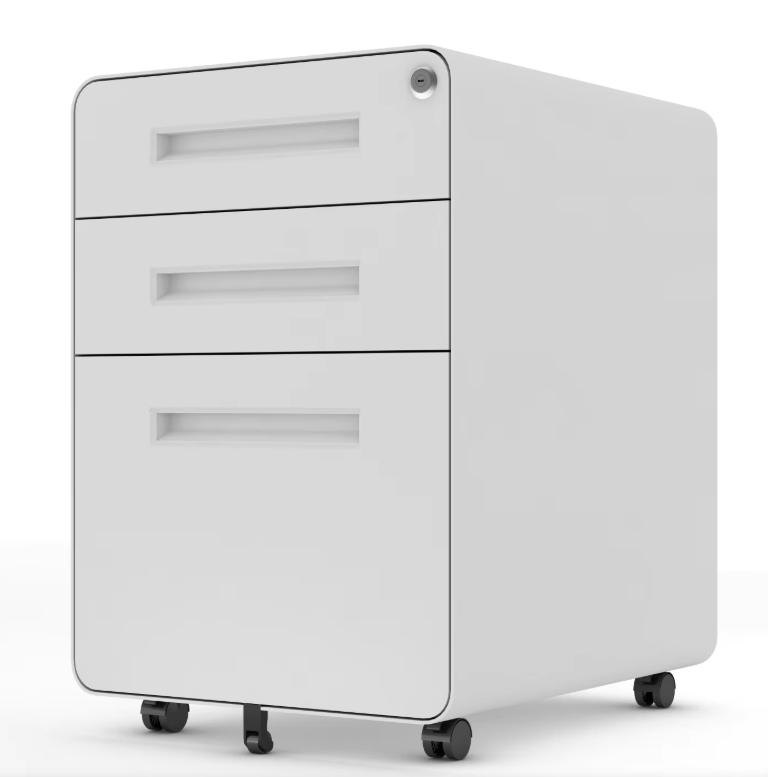
Reinforced Steel Frame: Unmatched Load Capacity and Stability for a Lockable Mobile Cabinet
Cold-rolled steel gauge specs and static load testing (up to 1,200 lbs)
A lockable mobile cabinet built for industrial use starts with cold-rolled steel in 12- to 16-gauge thicknesses—balancing panel rigidity with manageable weight for mobility. Its tighter grain structure improves resistance to bending under concentrated drawer loads compared to hot-rolled alternatives. Heavy-duty models reinforce side panels and incorporate full-height corner posts to distribute stress uniformly from top to base. In static load testing (2023), fully loaded configurations supported up to 1,200 lbs without permanent frame deformation. Load transfers directly from drawers and shelves into the frame—not through thin side skins—preventing point-load sagging and preserving door alignment over years of service. This optimized load path also reduces stress on welds and casters, ensuring safe rolling even near maximum capacity. For high-density tool storage, 14-gauge and 12-gauge steel typically form the base structure, while 16-gauge panels are used for doors and side panels.
Welded frame integrity vs. bolted alternatives: Why continuous seam welding prevents flex during transit
A welded frame functions as a single load-bearing unit, unlike bolted assemblies that rely on fastener friction and precise hole alignment. During transit, vibration and lateral forces can loosen bolts, allowing panel shift and compromising overall rigidity. Continuous seam welding eliminates those failure points by fusing panels into a monolithic structure, enabling even load distribution across the entire cabinet body. In practice, this translates to significantly less flex when moving over thresholds or uneven floors—critical because drawer slides and locking rods require a stable chassis to operate reliably. Even minor frame twist (a few millimeters) can cause drawer binding or central lock misalignment. Seam-welded frames are maintenance-free under normal use, unlike bolted alternatives requiring periodic retightening. Manufacturers further ensure long-term squareness using jig welding, preserving structural integrity after repeated relocations.
Simultaneous Locking System: Secure All Drawers and Doors in One Motion
A heavy-duty mobile cabinet requires a security mechanism that matches its structural strength. The simultaneous locking system ties every drawer and door to a single control point—so users secure the entire unit with one turn of the key or handle.
Three-point ANSI/BHMA Grade 1 certified locking architecture
The three-point locking architecture engages latches at the top, bottom, and side simultaneously. The top latch prevents outward prying of upper doors; the bottom latch anchors the lower drawer stack; and the side latch secures the door edge—spreading attack force across three reinforced frame locations instead of concentrating it at a single weak point. A central lock cylinder drives vertical rods and a horizontal cam, pulling all drawers and doors tight against the cabinet body. This design resists corner lifting, twisting, and pry-bar attacks more effectively than single-point systems. Because all latches operate from one control point, full engagement takes under two seconds. ANSI/BHMA Grade 1 certification confirms the lock body and strike components withstand at least 800,000 open/close cycles and high forced-entry torque—validating long-term alignment and latch performance in demanding applications like tool storage, medical carts, and industrial workstations.
Fail-safe interlock design prevents partial drawer extension during lock engagement
The fail-safe interlock ensures no drawer can extend while the lock is engaging or fully engaged. Each drawer slide features a blocking tab that mates with a vertical cam rail inside the cabinet. When the user turns the lock, the rail lowers and physically blocks every drawer runner—even if a drawer is slightly open—eliminating the partial extension vulnerability found in older lock systems. Inside the unit, the interlock also holds drawers flush with the cabinet face, stabilizing the center of gravity during movement. If a drawer isn’t fully closed, the lock handle won’t complete its rotation—providing immediate tactile feedback to correct before securing. This design prevents accidental access and protects stored tools from falling out during transit. Unlike spring-dependent mechanisms, it remains effective after repeated load cycles.
Heavy-Duty Dual-Wheel Casters: Full-Load Maneuverability Without Compromise
A lockable mobile cabinet must remain stable and easy to move even when fully loaded. Heavy-duty dual-wheel casters meet both demands.
Polyurethane-tread dual-wheel system: 30% higher floor-grip retention (ASTM F1715)
Each caster pairs two polyurethane-tread wheels, spreading load across a wider contact patch and lowering the cabinet’s center of gravity. Per ASTM F1715 traction testing, this configuration delivers 30% higher floor-grip retention than comparable single-wheel casters. The result is safer, more predictable movement under dense loads—whether tools, parts, or electronics. Twin wheels reduce point loading on facility floors and minimize caster flutter during straight-line transport. Operators can start, stop, and turn a fully loaded cabinet with less effort—even on epoxy or sealed concrete—without oversized wheel housings that compromise frame integrity or drawer access. Regular inspection of tread wear and bearing lubrication maintains this performance over years of daily use.
Modular Internal Layout: Reconfigurable Storage That Preserves Structural Rigidity
Interlocking Steel Panel Grooves and Captive Fasteners Enable Sub-90-Second Reconfiguration
A lockable mobile cabinet with a modular internal layout uses interlocking steel panel grooves to align dividers, shelves, and drawer partitions—no drilling or loose hardware required. Captive fasteners remain permanently attached to panels, enabling full reconfiguration in under 90 seconds without weakening the cabinet body. Each steel panel locks into the next, distributing load across the frame and resisting racking and vibration during movement. Users can adapt bins or adjust drawer compartments as workflows evolve—all while keeping contents secured behind the central locking system. Because only interior components change, the outer reinforced frame remains intact, preserving structural stability. This approach reduces setup time and supports lean tool control in maintenance and assembly environments.
Corrosion-Resistant Enclosure: Long-Term Durability in Demanding Industrial Environments
Electro-deposited primer + powder-coated finish: 1,000-hour salt-spray resistance (ASTM B117)
In humid, washdown, or coastal settings, a lockable mobile cabinet needs a coating system that resists creep, pitting, and undercutting corrosion. Electro-deposited primer—applied via immersion—ensures uniform coverage of recessed seams, drawer edges, and weld joints, bonding tightly to cold-rolled steel and blocking moisture penetration. A durable, chip-resistant powder-coated topcoat adds impact and chemical splash protection. Under ASTM B117 accelerated salt-spray testing, this dual-layer finish withstands 1,000 hours of continuous exposure without significant red rust or blistering—supporting reliable service life in marine workshops, food processing plants, and cleaning-agent–exposed storage areas. Since real-world performance depends on coating thickness and cure consistency, buyers should request test data specific to the cabinet model. This protective enclosure safeguards both the frame and stored contents in the most demanding industrial environments.
Frequently Asked Questions (FAQs)
Why is cold-rolled steel preferred for lockable mobile cabinets?
Cold-rolled steel offers higher resistance to bending and ensures better durability under heavy loads compared to hot-rolled alternatives. Its grain structure provides enhanced stability and panel rigidity.
How does continuous seam welding improve frame integrity?
Continuous seam welding fuses panels into a monolithic structure, preventing flex and ensuring even load distribution. Unlike bolted alternatives, it eliminates the risk of panel shifts and loosening over time.
What makes the three-point locking system secure?
It engages latches at the top, bottom, and side simultaneously to spread attack force across multiple reinforced points, making the cabinet highly resistant to prying, twisting, and forced entry.
Are dual-wheel casters better for heavy loads?
Yes, dual-wheel casters improve stability and floor grip by distributing weight over a larger contact area, allowing smoother and safer movement even under heavy loads.
Can the cabinet’s layout be reconfigured easily?
Yes, the modular internal layout with interlocking steel panel grooves allows reconfiguration in under 90 seconds while preserving structural rigidity.
How does the cabinet resist corrosion in industrial environments?
An electro-deposited primer and powder-coated finish provide excellent protection against rust, impact, and chemical splashes, ensuring long-term durability in harsh conditions.
Table of Contents
- Reinforced Steel Frame: Unmatched Load Capacity and Stability for a Lockable Mobile Cabinet
- Simultaneous Locking System: Secure All Drawers and Doors in One Motion
- Heavy-Duty Dual-Wheel Casters: Full-Load Maneuverability Without Compromise
- Modular Internal Layout: Reconfigurable Storage That Preserves Structural Rigidity
- Corrosion-Resistant Enclosure: Long-Term Durability in Demanding Industrial Environments
-
Frequently Asked Questions (FAQs)
- Why is cold-rolled steel preferred for lockable mobile cabinets?
- How does continuous seam welding improve frame integrity?
- What makes the three-point locking system secure?
- Are dual-wheel casters better for heavy loads?
- Can the cabinet’s layout be reconfigured easily?
- How does the cabinet resist corrosion in industrial environments?