
 EN
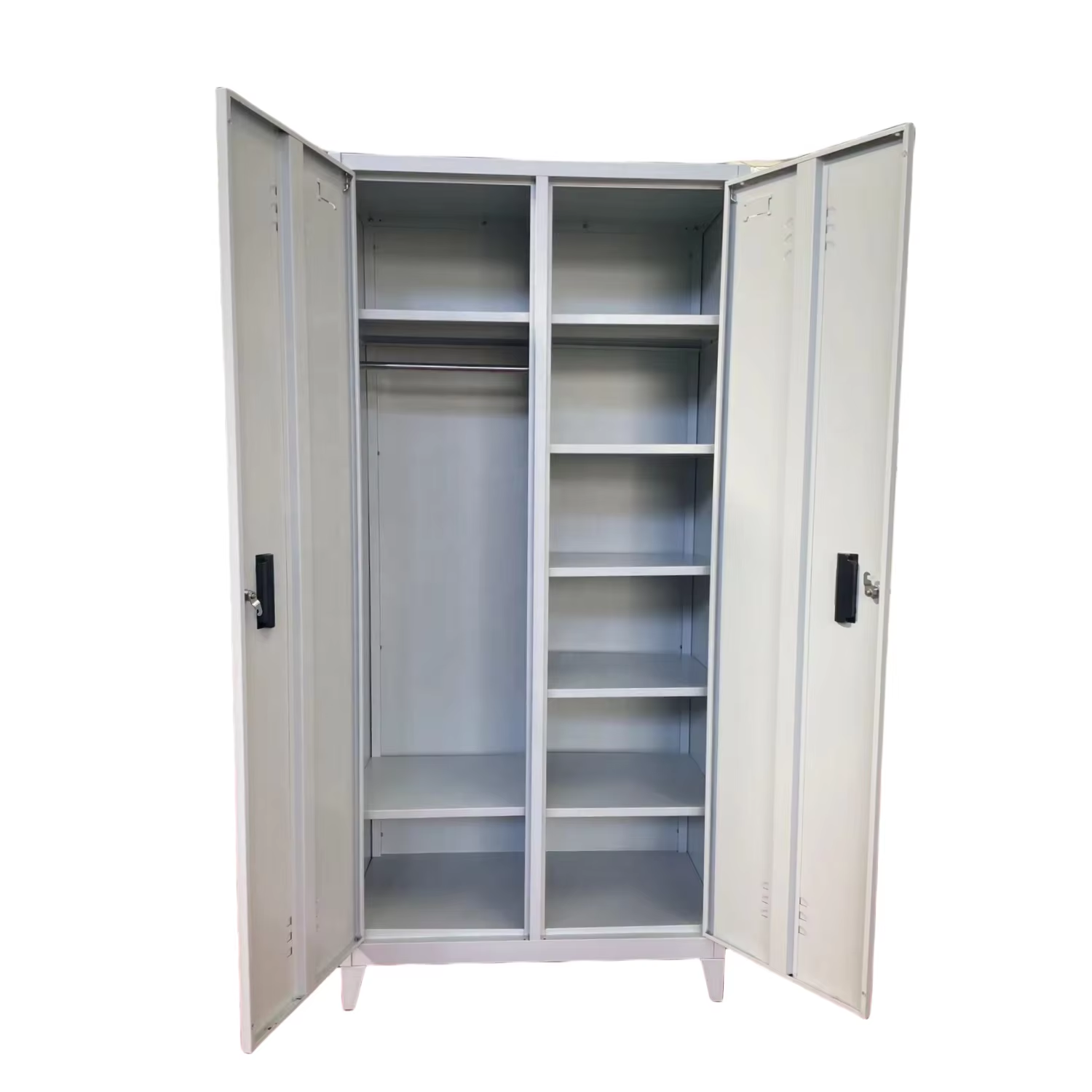
A maintenance team at a busy logistics depot replaced an entire bank of small single locker units eighteen months after installation. The finish was still fine. The doors were not: most had dropped a few millimetres, the cam latches no longer lined up, and staff had taken to lifting each door while turning the key. The units had been bought on a dimension and a colour, with no discussion of what held the door square. A small single locker is narrow, tall and opened dozens of times a day, so small structural decisions compound quickly. The five details below are the ones that separate a small single locker built for a catalogue from one built for a shift change.
Why door geometry decides how long a unit lasts
A small single locker door is a lever hanging on two or three hinges. Every opening cycle puts a little load into the hinge side and a little twist into the free edge, and gravity does the rest over a few thousand cycles.
When a sagging door stops being a cosmetic problem
On a small single locker, the first sign is usually a key that needs a second try. Then a scuff appears at the bottom corner, then the latch plate starts to wear a shiny groove. Once the door is out of square, the lock carries a side load it was never designed for, and a cylinder failure follows. Add a loaded coat hook and a bag pushed against the panel and the twist increases. On a small single locker there is very little panel width to absorb that movement, so the folded edges and the hinge reinforcement have to do the work. Buyers who only check the overall height and width miss this entirely. A door that closes with one finger on the first day should still close with one finger after a season of heavy use, and that behaviour is a structural outcome, not a finishing outcome.
Five structural details worth paying for
The useful small single locker comparison is not between two price lists. It is between two cut sheets, two weld layouts and two sets of hardware mounted on the same nominal frame.
A folded return along the free door edge
A small single locker door made from a single flat sheet flexes. Folding the sheet back on itself along all four edges creates a shallow box section, and that return raises stiffness far more efficiently than simply using thicker stock. Ask whether the return is a continuous fold or a separate welded strip, and check the corners where the folds meet. A well-made small single locker door has clean mitred corners and a consistent return depth, because an uneven return changes the gap at the latch. Run a finger along the inside edge of the sample: a sharp, unfinished burr there is a sign that the forming tools and the deburring step need attention.
Where the weld pattern actually carries load
On a small single locker, spot welds hold panels in position; they do not, on their own, carry the racking load of a tall narrow carcass. Look at the rear panel and the base joint, where stiffness comes from a continuous or closely spaced weld and from the way the back is folded into the side panels. Ask for the weld pitch and the treatment of the four corners after welding. Spatter, missed welds and heavy grinding marks all point to an inconsistent process. Where a supplier can show a controlled welding drawing, the conversation moves from opinion to evidence.
Keeping the base square on uneven floors
Real floors slope, and a small single locker feels it first. Adjustable levelling feet let an installer bring a bank into one plane, which keeps every door aligned with its own frame rather than with its neighbour. Without that adjustment, installers shim with whatever is at hand and the twist travels up the bank. Ask how the feet thread into the base, whether there is a reinforcing plate behind the thread, and where the anchor holes sit. Anchoring matters for a narrow unit: OSHA 29 CFR 1910.176(b) expects stored material to be stable, and a row of loaded doors opened at the same time is an obvious tip risk. Levelling and fixing are the simplest structural upgrades available on a small single locker.
Why louvre placement changes corrosion risk
Ventilation keeps damp clothing from sitting in a sealed steel box, but a row of stamped louvres is also a row of cut edges and a place where water collects. Louvres punched too close to the bottom edge trap mop water; louvres punched through a load-bearing fold weaken the panel. Good practice puts the openings high and low for a through-draught, away from the lock and hinge reinforcement, with the cut edges fully covered by the powder coat. That coating system should be backed by documented adhesion and corrosion testing, commonly ISO 2409 with ISO 9227 or ASTM B117 exposure, plus a written pretreatment step. Ask what happens at a scratched louvre edge six months into service.
Three-point engagement instead of one cam
On a small single locker, a single cam lock holds the middle of the door. A three-point bolt assembly pushes rods into the top and bottom of the frame as well, so the free edge cannot be pulled away from the carcass. Check the rod guides, the strike pockets and the thickness of the plate behind the cylinder. Where staff turnover is frequent, a resettable combination lock to UL 768 avoids a rekeying cycle; where a master key system is needed, get the key schedule written into the order. Any safety or user label on the door should follow ANSI Z535.4 so the wording and symbols stay legible and consistent across a whole bank of small single locker units.
What the standards actually check
Structural claims become verifiable when a named test method sits behind them, and the paperwork should match the model on the pallet.
Asking for evidence rather than adjectives
ANSI/BIFMA X5.9 and EN 14073-2 with EN 14073-3 set out stability, strength and safety expectations for storage furniture, including the kind of racking and door loads described above. A report from an ISO/IEC 17025 accredited laboratory, referencing the exact model and drawing revision, is worth more than a page of superlatives. ISO 9001 speaks to whether the weld pitch and coating pretreatment stay the same from batch to batch, so ask for the inspection record from the same production run. NFPA 101 enters at installation, because a bank of doors must not narrow an exit route, and ANSI Z535.4 covers the labels. None of these documents make a cheap frame stiff; they simply make the difference visible before the container is booked.
Inspecting the same details after installation
Open ten small single locker doors at random and close each with one finger. Look along the bank at eye level for a door that sits proud, then check the levelling feet and anchors under that unit. Photograph any chipped return edge during the first month, since chips at folds are where coating failure starts. Wipe the louvres clear, keep solvent cleaners away from the powder coat, use dry graphite rather than oil in the cylinders, and recheck hinge screws at the next term break. A heavy duty small single locker that was specified properly is easy to maintain; one that was specified by photograph keeps a maintenance team busy. Huawei Furniture in Luoyang, founded in 1992, works from customer plans and samples with an in-house design team, which is the sort of arrangement that lets a buyer lock these five details into a drawing before production begins.
Frequently Asked Questions
Which single detail has the biggest effect on door alignment?
On a small single locker, the folded return along the free edge, together with the hinge-side reinforcement, does most of the work. A flat door panel twists under its own weight, while a folded edge behaves like a shallow beam. Check the return depth on the sample, look at how the corners are finished, and confirm that the hinge mounting area has a backing plate. Those three observations predict alignment better than any stated sheet thickness.
Does a three-point lock really matter on such a narrow door?
It does, because a narrow door concentrates prying force at the free corner. A single cam holds only the middle, so the top corner can be pulled clear of the frame. Three-point engagement spreads that force to the top and bottom strikes and keeps the gap even. Look for solid rod guides and a reinforced plate behind the cylinder, and make sure the key schedule or code reset procedure is written into the purchase order.
How should ventilation be judged on a locker sample?
Look for high and low openings that create a through-draught, placed clear of the hinges, the strike and the folded edges. Cut edges should be smooth and fully covered by the coating, with no raw steel visible inside the louvre. Ask which pretreatment and powder system is used and request adhesion and corrosion results with the method named, such as ISO 2409 and ISO 9227. Ventilation that weakens the panel is not a feature.
What documents should accompany a heavy duty locker order?
Ask for a controlled drawing with a revision number, a bill of materials naming the lock and hinge models, an inspection record from the actual production batch, and any third-party test report against ANSI/BIFMA X5.9 or EN 14073-2 and EN 14073-3. REACH and RoHS declarations cover the finish and fittings. Check that every document carries the same model code as the quotation, since a report for a wider cabinet says little about a single-door unit.
Is anchoring necessary for a bank of lockers?
A row of tall narrow units with doors opening toward the aisle should be fixed, especially where trolleys pass or staff lean on the doors. OSHA 29 CFR 1910.176(b) expects stored material to be secured against tipping, and NFPA 101 keeps exit widths usable. Request the anchor point locations and fixing type from the factory, then let the site team select fasteners suited to the actual floor or wall substrate.
What does a sensible maintenance routine look like?
Check door gaps and levelling feet once a term or quarter, tighten hinge screws, clear dust from the louvres and wipe the bottom edge dry after floor cleaning. Use dry graphite in lock cylinders, avoid abrasive pads and solvent sprays on the powder coat, and touch up chips at folded edges promptly. Keep a dated log of adjustments. That record turns a recurring complaint into a specific drawing change for the next order.