
 EN
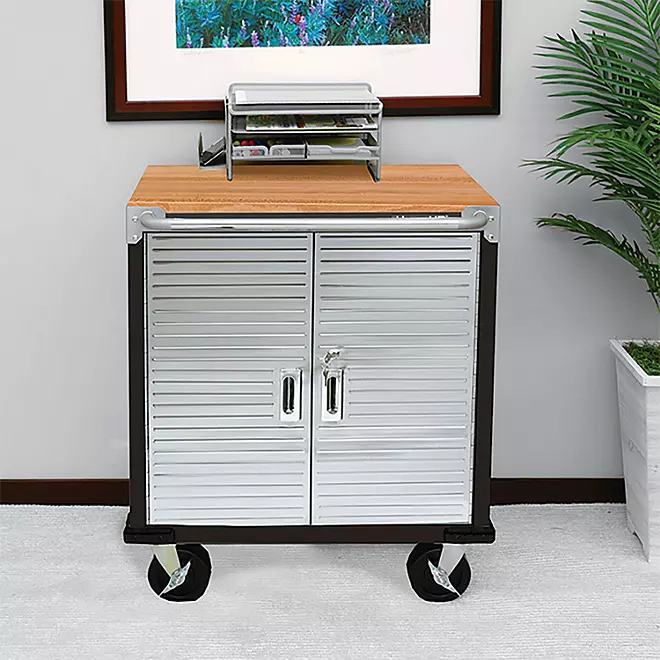
All-Welded Steel Construction for Maximum Rigidity and Load-Bearing Performance
How continuous weld seams eliminate flex points under dynamic stress
A heavy-duty steel cabinet with all-welded construction behaves as a single, unified structure—not a collection of joined panels. Continuous weld seams fuse side, top, back, and base into one rigid frame, eliminating the small gaps and mechanical interfaces inherent in bolt-together assemblies. Under dynamic stress—such as repeated door slamming, shifting tools, or floor vibration—bolted cabinets develop flex points at panel junctions. These zones concentrate stress, loosen over time, and accelerate fatigue. In contrast, continuous welds distribute force along the entire seam. With no hole clearance or fastener slip, the cabinet maintains dimensional stability, resists racking and twisting, and avoids stress risers that initiate cracks under cyclic loading. This structural integrity is especially critical in high-traffic workshops or mobile service environments, where cabinets must remain square and load-bearing surfaces stable despite frequent, uneven loading. The absence of bolt holes also reduces entry points for moisture and debris—further supporting long-term performance. As a result, the welded shell deforms less under heavy or shifting loads, delivering more predictable, consistent behavior.
Case Study: 40% higher static load capacity vs. bolt-together units (UL 2085 test data)
Controlled UL 2085 testing (2023) confirmed that all-welded steel cabinets achieve 40% higher static load capacity than comparable bolt-together units of identical gauge and dimensions. The test applied progressive vertical load until permanent deformation occurred. Welded assemblies transferred weight through the full cross-section of steel at every joint; bolt-together cabinets concentrated load at fastener holes and thread contact areas—reducing effective bearing area and creating early failure zones. That 40% gain translates directly to safer support for heavier tools, dies, or stacked inventory without sagging, seam separation, or loss of door alignment. Because welded performance doesn’t depend on assembly torque or fastener retention, it remains stable across years of service. Field experience in maintenance bays—where cabinets routinely hold heavy, irregularly distributed loads—shows markedly fewer seam failures compared to bolted alternatives. For applications where load-bearing reliability is non-negotiable, UL 2085 data strongly support specifying all-welded construction.
Optimized Steel Gauge Selection: Why 14-Gauge and 22-Gauge Matter for Real-World Durability
A steel cabinet’s long-term durability starts with gauge selection. Lower gauge numbers indicate thicker sheet: 14-gauge measures 0.0747 in, while 22-gauge measures 0.0336 in. Both typically use low-carbon steel with similar tensile yield strength, so raw alloy isn’t the primary durability variable—the decisive factor is cross-sectional thickness and how it resists bending, denting, and fatigue.
Tensile strength benchmarks: 14-gauge (0.0747") vs. 22-gauge (0.0336") in impact resistance testing
Though base tensile strength is comparable, 14-gauge offers a 2.2× greater material thickness than 22-gauge—and because bending resistance scales with the cube of thickness, its stiffness advantage is substantial. In ASTM E643 (2023) drop-weight impact testing, 14-gauge panels consistently resisted visible denting at significantly higher energy levels than 22-gauge panels of the same grade. Thickness also improves tear resistance around punched holes, weld zones, and shelf mounting points—critical when struck by tool carts, fork tines, or dropped workpieces. While 22-gauge may suffice for low-contact applications like records or light parts storage, impact-prone settings demand the resilience of 14-gauge to avoid panel replacement and frame misalignment.
When 14-gauge is non-negotiable: High-vibration environments and heavy tool storage use cases
In high-vibration environments—generator rooms, CNC machining cells, stamping areas—thin-gauge steel has little margin for fatigue. Continuous vibration can degrade sheet metal, crack weld seams, and loosen hinges. 14-gauge adds mass and stiffness that dampen resonant flex and preserve cabinet squareness over time. Similarly, heavy tool storage imposes both concentrated static loads and frequent impacts: shelves loaded with dies, gear pullers, and large wrenches increase risk of bowing, tearing at shelf supports, or latch binding in thinner panels. Though 14-gauge carries a higher initial cost, the Industrial Storage Durability Review (2023) found its extended service life often reduces total replacement expense over a five-to-seven-year horizon. For tool cribs, maintenance bays, and equipment rooms, 14-gauge isn’t over-engineering—it’s the practical baseline for reliable load-bearing performance.
Pan-Reinforced Door Panels Ensure Long-Term Warping Resistance and Seal Integrity
How stamped ribbing increases panel stiffness by up to 3.2× without adding weight
Pan-reinforced door panels use precision-stamped ribbing to dramatically increase stiffness without increasing steel gauge or overall weight. By raising the panel’s section modulus, the ribs boost bending resistance—up to 3.2× higher than a flat panel of identical thickness. This enhanced rigidity prevents corner twisting during repeated opening, closing, and incidental contact in busy workspaces. It also ensures even gasket compression along the full door perimeter—essential for maintaining seal integrity against dust, moisture, and airborne shop debris. Because the reinforcement is formed directly from the base sheet—not added via welding or bolting—the panel retains ease of operation while resisting warping over years of daily use.
Full-Height Piano Hinges Deliver Uniform Load Distribution and Enhanced Cycle Life
Why 36" continuous hinges outperform three-point hinge systems in repeated-cycle fatigue tests
Full-height piano hinges—running the full 36-inch edge of a heavy-duty steel cabinet door—distribute load continuously rather than concentrating it at discrete knuckle points. In repeated-cycle fatigue testing simulating thousands of open-close operations, continuous hinges demonstrated significantly lower localized wear and deflection than three-point systems. Three-point hinges transfer force through small contact zones that can loosen under heavy doors or frequent access, leading to misalignment and compromised seals. A continuous hinge eliminates those stress risers, preserving door alignment, ensuring smoother operation, and extending service life—without requiring complex reinforcement. This design is especially valuable in high-use industrial and electrical enclosures where reliability, seal integrity, and long-term performance are mission-critical.
FAQ
What are the benefits of all-welded steel construction?
All-welded steel construction eliminates flex points under stress, maintains dimensional stability, and ensures long-term rigidity, resisting fatigue and deformation under heavy use.
Why is 14-gauge steel preferable to 22-gauge steel?
14-gauge steel offers a higher resistance to bending, denting, and fatigue due to its greater thickness, making it ideal for high-vibration environments and heavy tool storage.
How do pan-reinforced door panels improve durability?
Pan-reinforced doors use stamped ribbing to boost panel stiffness and resist corner warping, ensuring a consistent seal against dust and moisture over years of use.
What advantages do full-height piano hinges provide?
Full-height piano hinges evenly distribute load along the door edge, reducing localized wear and extending the life span of heavy-duty cabinets.
Table of Contents
- All-Welded Steel Construction for Maximum Rigidity and Load-Bearing Performance
- Optimized Steel Gauge Selection: Why 14-Gauge and 22-Gauge Matter for Real-World Durability
- Pan-Reinforced Door Panels Ensure Long-Term Warping Resistance and Seal Integrity
- Full-Height Piano Hinges Deliver Uniform Load Distribution and Enhanced Cycle Life
- FAQ