
 EN
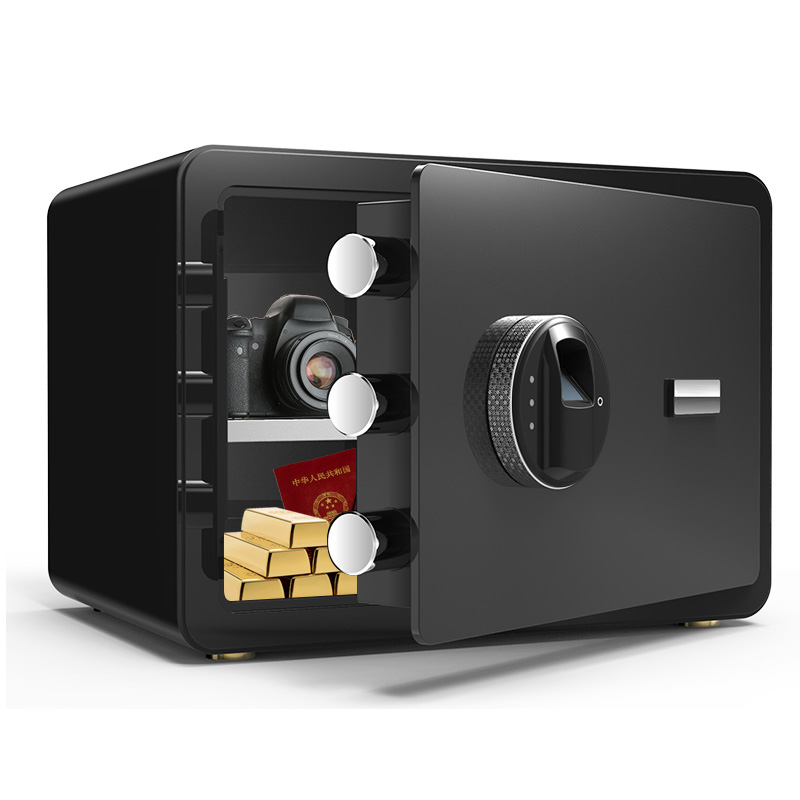
A retail group ordered small safe units for the back office of every branch, then discovered that the standard document wallet used by its stores would not fit through the door opening. The external dimensions on the quotation were correct. Nobody had asked for the clear internal width, shelf height or the space the boltwork takes up. A small safe is bought for a restricted footprint, which means every millimetre of the inside is contested between the door, the barrier layer and the locking mechanism. Sourcing one well is mostly about replacing a catalogue size with a usable dimension and a fixing plan.
Where compact orders go off track
A smaller enclosure removes the slack that a large cabinet gives a buyer. Two problems tend to be discovered too late.
A size that fits the room but not the contents
For a small safe, ask for a section drawing with clear internal width, depth and height, the shelf positions and the space taken by the door assembly when it is open. Compare those with the actual items going inside: document wallets, media cases, key bundles, till cassettes or prescription pads. Where a fire class is claimed, the insulated barrier and the intumescent seal eat into the internal volume, so the usable box is smaller than the outer shell suggests. A small safe that has to be packed to its absolute limit is also hard to audit, because retrieving one item means moving everything else. Put the intended contents list into the order.
Treating weight as a fixing method
A compact unit is easy to pick up, which is a different risk profile from a full-height cabinet. On a small safe, look for accessible anchor holes in the base or rear panel, with a reinforcing plate behind each one, and ask for the anchoring method described in any rating report. A small safe sitting loose under a counter can be carried out during a break-in, together with its contents. The factory supplies the fixing point locations and a kit; the installer chooses fasteners for the actual timber, screed or masonry. NFPA 70 is a reminder to check for services before drilling behind a counter, and the fixing choice should be recorded in the site file.
Reading the build at a reduced scale
Shrinking a cabinet into a small safe does not scale every part evenly. The structure has to be judged on its own terms.
Folded returns, rebates and the latch line
A small safe door has less panel width to resist twisting, so a folded return along all four edges does more for stiffness than extra thickness. Ask whether the door sits in a rebated frame, since a flat overlap leaves a straight prying gap, and check the strike pockets and the plate behind the cylinder. Cold-rolled sheet is formed, welded and then coated; request adhesion and corrosion results with the method named, such as ISO 2409 cross-cut adhesion alongside ISO 9227 salt spray, and confirm that folded edges are fully covered. A small safe should still close with one finger after a season of daily use, and that behaviour comes from the forming rather than the finish.
Locks, liners and the space they consume
For a small safe, decide the locking approach before the internal layout is fixed. A resettable combination lock to UL 768 suits sites with staff turnover, while a keyed system needs a documented master key schedule and spare key custody. A three-point bolt assembly improves resistance but takes room along the door edge, so it belongs in the section drawing. A lift-out liner protects contents from banging against the steel and makes cleaning possible; check that it does not block the boltwork. Where an electronic lock is fitted, ask for the battery bay position and the low-battery indication. Every one of these choices changes the usable internal space on a small safe.
Standards that belong in the order
Standards separate furniture stability, security rating and site duties, which is exactly the mix a compact unit sits in.
Placing ANSI/BIFMA X5.9, UL 72 and NFPA 1 in the file
ANSI/BIFMA X5.9 and EN 14073-2 with EN 14073-3 give stability, strength and safety criteria for storage furniture, relevant where a small safe sits on or under a worktop. Fire exposure is covered by UL 72, forced entry by UL 687 or EN 1143-1, lighter duty by EN 14450, and the code mechanism by UL 768. Ask for the sheet naming the quoted model, issued by a test house holding ISO/IEC 17025 accreditation. On the premises, NFPA 1 and NFPA 101 govern placement and egress, NFPA 70 a wired keypad, and OSHA 29 CFR 1910.176(b) stable storage. Label artwork follows ANSI Z535.4; REACH and RoHS cover the finish.
Where ISO 9001 and ISO 2859-1 keep sites consistent
Repeatability of the internal dimensions, anchor hole pattern and lock model is an ISO 9001 matter; ask for a controlled drawing with a revision number and an inspection record from a real batch. ISO 2859-1 gives a defensible incoming sampling plan, which matters more on a multi-site rollout than on one delivery. Add a written packaging specification with a parcel sequence test, since a small safe often ships as a single carton to each branch. Huawei Furniture, a Luoyang steel office furniture maker founded in 1992, introduced mail-order packing to its local industry early on, which is the kind of experience that shows up in the carton drawing rather than in a product photograph.
A site sheet for every branch
Write one small safe sheet with the clear internal dimensions, the intended contents list, the anchor point locations, the fixing guidance for common substrates, the lock model and key or code schedule, the asset numbering rule and the drawing revision. Require written approval before any change to the door, liner or lock. At goods-in, open cartons from several pallet positions, measure the clear internal width against the sheet, place one real document wallet inside and close the door, then check the anchor holes are reachable with the unit in position. Record which fasteners were used at each site. A small safe program built on that sheet is easy to repeat in a new branch, because the dimensions and the custody rule already exist.
Frequently Asked Questions
Which dimensions should be on the specification?
For a small safe, clear internal width, depth and height, shelf positions, the space taken by the door assembly when open, and the door opening itself. External dimensions alone say little about usable capacity, especially where a fire-rated barrier and an expanding seal sit between the skins. Put the intended contents list in the order and test one real item inside the sealed sample before the rest of the batch ships.
Does a compact unit still need anchoring?
Yes. A smaller enclosure is easier to carry away than a full-height cabinet. Ask for accessible anchor holes with a reinforcing plate behind each one and the anchoring method described in any rating report. The factory supplies the locations and a kit; the installer chooses fasteners for the actual substrate and checks for services before drilling. Record the fixing choice in the site file.
Which standards apply to a unit placed under a worktop?
ANSI/BIFMA X5.9 and EN 14073-2 with EN 14073-3 cover stability, strength and safety of storage furniture. UL 72 addresses fire endurance classes, UL 687 and EN 1143-1 attack resistance, EN 14450 lighter secure storage in S1 and S2 classes, and UL 768 combination locks. NFPA 1 and NFPA 101 concern placement and escape routes, and ANSI Z535.4 the user label.
How should the lock be chosen?
Decide before the internal layout is fixed, because the mechanism consumes space. A resettable combination lock to UL 768 suits high staff turnover; a keyed system needs a master key schedule and spare key custody in writing. A three-point bolt assembly improves resistance but takes room along the door edge. Where an electronic lock is used, ask for the battery bay position and low-battery indication.
What belongs in a multi-site rollout sheet?
Clear internal dimensions, the intended contents, anchor point locations, fixing guidance for common substrates, the lock model and key or code schedule, asset numbering and the drawing revision. Require written approval before any substitution. At goods-in, measure the clear width, place one real item inside, close the door and confirm the anchor holes are reachable with the unit in position.
Which documents should be requested from the supplier?
A controlled drawing with a revision number, a bill of materials naming the lock and hinge models, an inspection record from a real batch and any rating report with the exact model code. Check the laboratory’s ISO/IEC 17025 accreditation, add REACH and RoHS declarations for the coating and electronics, and ask for the packaging drawing with its transit test. Keep one sealed sample at each end