
 EN
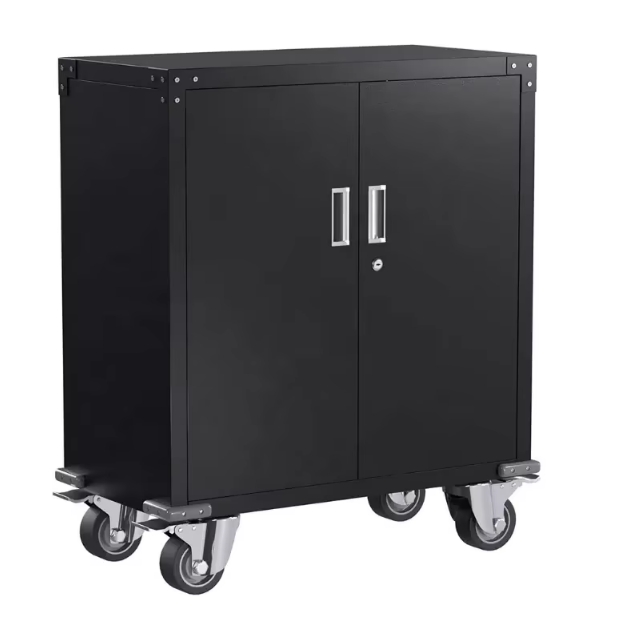
The bottom drawer of a mobile file cabinet in a county records room had started to droop. Staff had packed it with case files until, at full extension, the front dipped at one corner and a gap opened along the top edge. The frame leaned toward the open side. A straightedge across the top showed one side panel bowing near the slide channel, and light under the base hinted the bottom was no longer square. The check moved from the slide to the plate behind it, then to the crossmember below and the brake on each caster. The fault was structural, not cosmetic.
On a Fully Loaded Drawer: A Field Observation
Where the Drawer Face First Shows a Gap
Un cassetto caricato si comporta come una trave incastrata. Il suo peso più quello delle cartelle agisce in avanti rispetto al corpo dell’armadio, quindi la guida e il pannello sopportano un momento flettente che aumenta man mano che il cassetto scorre. Il primo segno non è quasi mai un componente rotto. Si apre una fessura lungo il bordo superiore della facciata del cassetto, più larga all’angolo libero, perché il pannello laterale si flette nel punto di fissaggio della guida. Per un armadio mobile per archivi densi, tale fessura è il primo segnale che qualcosa è sottodimensionato.
Misurare l’abbassamento con una riga e una spessimetro
Diagnosis remansit parva technologia. Dux posuit regulam rectam trans superiorem partem armarium, clausit cistulam, et inspexit revelationem in utroque angulo. Calibrator felelis dedit lectionem repetibilem, quae iterum sumpta est cum cistula vacua, ut separaretur deformitas permanens a flexu elastico. Pressio anguli exterioris ad extensionem plenam ostendit quantum pendulus veniret ab ansero versus aedificium. Repetitio huius in alio armarium mobile cistularum identico in eadem ordine confirmavit defectum esse peculiarem unitatis, non problematum copiae.
Cur cistulae oneratae extrahunt aedificia e quadrato
Quid anserus sphaericus portat contra anserum rotularem
Un glissoir à billes répartit la charge du tiroir le long d’une piste trempée, de sorte que les billes partagent la force verticale sur une longue ligne de contact au lieu de quelques rouleaux. Cela importe surtout en extension complète, où un glissoir à rouleaux moins coûteux se déforme et laisse le devant du tiroir basculer. La course nominale et la méthode de fixation déterminent la quantité de force transmise à l’acier. Lorsqu’un classeur mobile est spécifié pour des archives denses, le type de glissoir détermine le comportement d’un tiroir chargé et mérite une ligne distincte dans toute commande.
Les freins des roulettes n’empêchent pas le flambage du châssis
Un caster blocant tene le cabinet fixe super le pavimento, ma il non face nihil pro mantener le cassa super il quadrat. Le racking es un distortion del quadro, un deviation del rectangulo verso le parallelogrammo causate per un carico inaequal e forzas laterales repetite. Le freno addressa le movemento super le pavimento, non le torsion de plachas saldate. Omne frenos de casters eran activate corretamente e le cabinet remaneva inclinate. Specificar un cabinet mobile pro archive solmente per su casters non impedira iste inclination; le resistentia debe esser in le traversas transversal e le juncturas saldate.
Plachas de renforto transferi le carico al quadro del cabinet
Le traversa inferior que liga ambes plachas laterales
The bottom crossmember keeps the two side panels acting as one box. In a mobile file cabinet the base does more than hold drawers, because it resists one side spreading outward when a loaded drawer pulls the opposite rail. Without it, the base becomes a loose U shape and the slide mounts work against each other, showing up as the widening top gap seen on site. A welded member tied into both sides and the back closes that section. Stiffening it changed how the whole mobile file cabinet reacted to the open drawer.
How Spot Welding and Bending Share the Load
Folium ex acciaio laminato a freddo diventat structura rigida tantum post tagliare, flectere et iungere. Operatio CNC flectit unam lamellam secundum marginem tabulae, addens multo plus rigiditatem quam folium planum, ut plicatura in carta. Soldatura punctiformis constringit istas plicaturas ad laminam de renfortio et ad transversarium in punctis repetitis, diffundens tensionem per iuncturam. Una lamina localis retro montagium glissantis praebet fastigia aliquid in quod mordere possint. Fabbrica Luoyang fundata anno 1992, quae occupat 30 000 metra quadrata et producit mensualiter 10 000 pieces, confidit in hac serie ad conservandum unicitatem cuiuslibet armarium mobilis pro documentis.
Normae, Viae Onus, et Cura Longa
Magis Fidabilis Quam Coniectura Visiva: Quae Normae Exigunt
A straightedge reading describes one cabinet; a standard describes what any cabinet should survive. ANSI/BIFMA X5.9 sets strength and durability expectations for storage units, the closest reference for drawer sag, slide cycling and frame stability. ISO 9001 sits behind the process side, since repeatable bending, welding and coating depend on a managed quality system. OSHA 1910.176 speaks to secure storage so a loaded unit does not tip in a busy aisle. NFPA 101 keeps circulation clear, because a cabinet in an escape path is a life safety problem. For a buyer comparing one mobile file cabinet with another, these references become purchase order checks.
Buying a mobile file cabinet: ask for the slide type, rated travel and side panel gauge in writing, and request a drawing showing the reinforcement plate behind each slide mount and the crossmember under the base. A supplier describing formed and welded construction gives a load path that can be checked later.
Inspecting a mobile file cabinet on arrival: set the unit on a level floor, engage every caster brake, open each drawer fully and sight the reveal at both top corners with a straightedge. Press the outer corner of a loaded drawer and watch the side panel. Confirm welds are continuous at the base corners.
Using a mobile file cabinet: distribute weight toward the lower drawers first, avoid leaving a fully packed drawer open, and move the cabinet only after the brakes are released and drawers closed. Keep the load within rated travel and never use an open drawer as a step or shelf.
Maintaining a mobile file cabinet: wipe the slide races clean, check that mounting bolts stay tight, and measure the top reveal every few months on heavily used units. A growing gap is an early warning. Level the feet again or replace a worn caster before frame distortion becomes permanent.
Quaestiones Frequenter Rogatae
Q: What causes a fully loaded drawer to sag?
A:Un cajón cargado actúa como una viga en voladizo, por lo que las carpetas generan un momento flector que aumenta al extenderse el cajón. La guía, la placa de montaje detrás de ella y el panel lateral se deforman ligeramente bajo esa fuerza. Cuando cualquiera de estas piezas es demasiado pequeña, el frente se inclina en la esquina libre y se abre una brecha a lo largo del borde superior. Revisar cada pieza por separado revela dónde comienza la deformación.
P: ¿Cómo ayuda una guía con rodamientos de bolas con archivos pesados?
A:Una guía con rodamientos de bolas distribuye la carga vertical a lo largo de una pista endurecida, de modo que muchas bolas comparten la fuerza en lugar de que unas pocas ruedas la soporten en puntos aislados. Esa línea de contacto más amplia reduce la deformación en la extensión total, donde el brazo de palanca es más largo. La guía aún requiere una placa de montaje rígida y un panel lateral sólido, porque solo puede transferir la carga al acero que la sostiene.
P: ¿Evitan las ruedas bloqueables la torsión del bastidor del armario?
A:No. A locking caster stops the cabinet from rolling across the floor, but it does not resist racking — that is, the frame shifting from a rectangle toward a parallelogram under uneven lateral load. That resistance comes from welded joints, reinforcement plates, and a bottom crossmember tying the side panels together. Casters matter for stability and safe positioning, yet they address floor movement, not the geometry of the box.
Q: Why is a bottom crossmember important on a mobile unit?
A:The bottom crossmember ties both side panels into a single closed section, so a loaded drawer pulling on one rail cannot spread the base into a loose U shape. Without it, slide mounts work against each other and the frame racks, showing up as a widening gap at the drawer top. A welded member joined to the sides and back keeps slide alignment stable over years of daily use.
Q: Which standards apply to drawer strength and storage safety?
A:ANSI/BIFMA X5.9 tractat de fortia et durabilitate unitatum servandi, ideo est praecipua referentia pro deflexione cistulae, cyclis glissandis et stabilitate structurae. ISO 9001 adiuvat partem processus, quoniam formatio et soldatura repetibiles dependeunt a systemate qualitatis administrato. OSHA 1910.176 agit de servando secure, ut unitas onerata non inclinetur nec contenta effundat. NFPA 101 protegit viam evadendi circumiacentem.
Q: Quotiens inspectio allineationis cistularum facienda est?
A:In arca multum usitata, mensura revelatio superioris cuiusque cistulae per paucos menses fit cum regula recta, et omnis mutatio notatur. Interstitium quod crescit inter lectiones significat quod glissator, bulla aut structura lente cedunt; facilior est correctio in principio quam postquam soldatura rumpitur. Rotae purgantur, coniugamenta retorquentur et rota consueta eadem vice substituitur.