
 EN
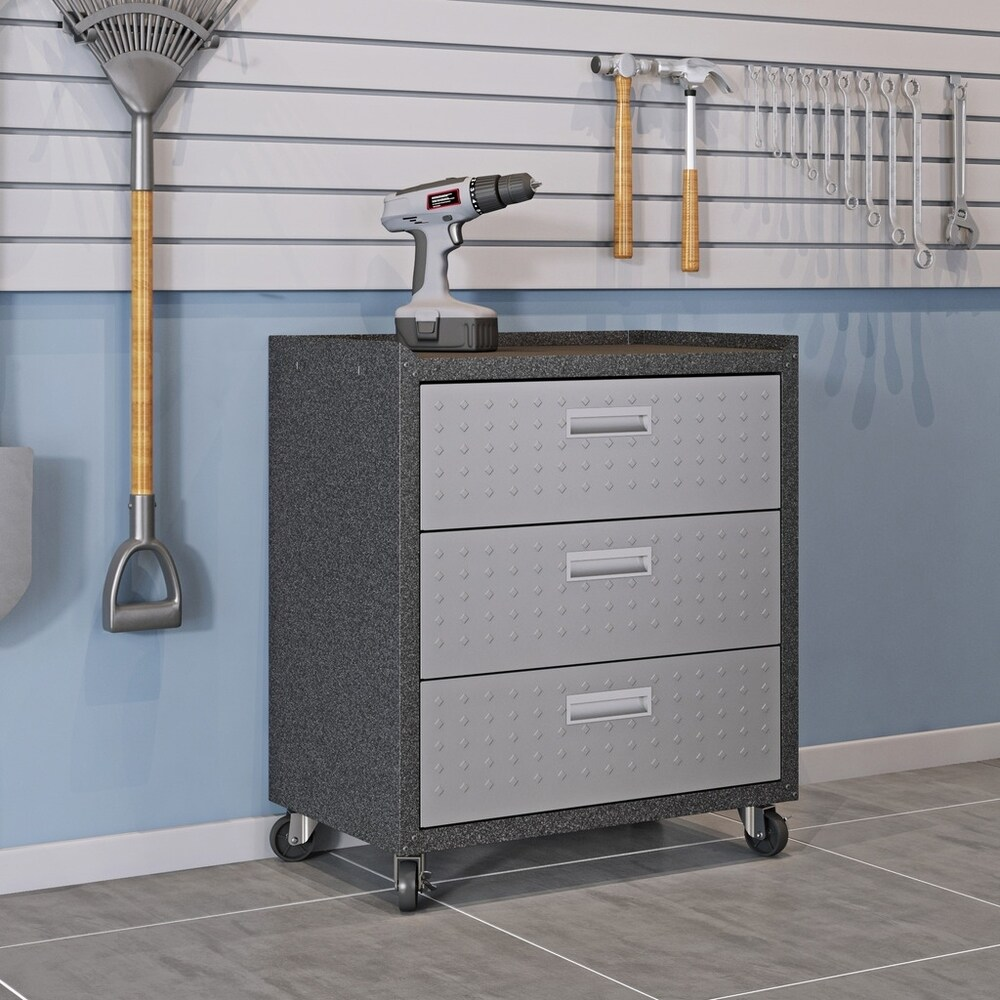
14-Gauge Welded Steel Construction: The Foundation of Structural Integrity
The structural performance of a lockable metal cabinet begins with its steel shell. Material thickness and joint design determine how the unit resists load, impact, and forced entry.
Why 14-Gauge Steel Delivers Superior Load-Bearing Rigidity
14-gauge steel measures approximately 0.075 inches thick—about 56% thicker than the 18-gauge sheet metal (0.048 inches) used in light-duty storage. This added thickness increases section modulus, significantly improving bending resistance. As a result, side panels and the top deck resist deflection under full shelf loads, minimizing twisting, door misalignment, and racking on uneven floors. In workshops and industrial settings—where heavy tools, parts, and equipment are routinely placed on shelves and against walls—the 14-gauge panels form a true load-bearing box, not a thin wrapper. The extra rigidity supports heavy shelving without requiring a dense internal frame, while also enhancing dent resistance and reducing side-wall bulging. Specifiers choose 14-gauge steel for its proven balance of weight, cost, and structural reserve—key to maintaining door alignment with locking points over time.
Welded vs. Bolted Assembly: How Seamless Joints Eliminate Point-Failure Risks
Bolted cabinets rely on discrete fasteners at corners and shelf supports—each bolt hole acting as a stress concentration where metal can tear under repeated or heavy loads. Over time, vibration, impact, and thermal cycling can also loosen these connections. Welded assembly eliminates those weak points entirely. Continuous welds fuse panels into a single rigid structure, allowing load to flow directly through the joint rather than around a fastener. With no exposed bolt heads to attack, welded cabinets resist prying at door edges and corners more effectively. Seamless joints also reduce moisture traps that accelerate corrosion. During forced-entry attempts, welded corners maintain integrity even when the face is struck—providing the locking system with a stable, unyielding frame to anchor against. For this reason, heavy-duty enclosures consistently favor welded construction over knock-down hardware: fewer failure points, greater durability, and longer service life.
Engineered Load Capacity: Supporting Up to 1,450 lbs per Shelf
Structural load capacity depends not just on material gauge but on shelf span, bracing, and engineering validation. A properly engineered lockable metal cabinet distributes weight evenly and supports up to 1,450 lbs per shelf under a uniformly distributed load (UDL).
Reinforced Trusses and Cross-Bracing: Preventing Shelf Sag Under Maximum Load
Plain flat shelves deflect under heavy loads—especially when unsupported spans exceed 48 inches. Industry testing shows wire shelf capacity drops from 800 lbs to 600 lbs as length increases from 48 to 72 inches, primarily due to center bending. Reinforced trusses—zigzag or channel-shaped supports welded beneath the shelf deck—redirect load outward to vertical posts, dramatically reducing mid-span deflection. Cross-bracing between rear and side panels resists lateral racking and preserves cabinet squareness. When combined with dual-layer columns and reinforced ribs, this approach enables heavy-duty systems to hold up to 2,000 lbs per shelf in 12-gauge steel. In a 14-gauge cabinet built to this standard, each shelf remains flat and stable at its full 1,450 lb UDL rating. Without such reinforcements, welds and shelf edges face point-failure risks—leading to sag and eventual collapse.
ASTM F2673-22 Validation: Real-World Static and Dynamic Load Testing Results
ASTM F2673-22 provides standardized methods for evaluating load-bearing furniture under both static and dynamic conditions. To meet this benchmark, manufacturers test shelves at 125% of rated capacity and measure deflection, weld integrity, and recovery after unloading. In evaluations aligned with ASTM F2673-22, a 1,450 lb-rated shelf demonstrates average deflection below 0.25 inch at full UDL and returns close to flat after unloading. Cyclic dynamic tests—simulating 10,000 load/unload cycles—show no weld cracking or fastener loosening. Crucially, door and lock alignment remain stable under full load, preserving both security and structural cohesion. This validation transforms a nominal load rating into a repeatable, field-proven performance guarantee—giving buyers confidence that the cabinet will safely support heavy tools, parts, and equipment over years of demanding use.
Integrated Locking System: Enhancing Security Without Compromising Structural Cohesion
Security hardware on a heavy-duty cabinet is effective only when it reinforces the enclosure frame—not weakens it.
3-Point Locking + Continuous Hinges: Dual-Function Hardware That Reinforces Frame Stability
A 3-point locking system secures the door at the top, middle, and bottom of the frame—spreading prying force across three anchor points instead of concentrating it at a single latch. This reduces door flex, improves closure tightness, and lowers stress on surrounding metal. Continuous hinges support the door along its full height, distributing weight evenly and preventing sag. When the door stays square, locking rods engage more reliably—and the hinge/lock system itself acts as a structural brace. Together, they resist twisting, preserve cabinet geometry, and help the enclosure retain its shape during daily use and forced-entry attempts. Unlike add-on security features that introduce movable parts prone to wear or misalignment, this dual-function hardware strengthens the frame while maintaining long-term reliability.
Padlock Hasps and Slide Bars as Shear-Resistant Anchors
Padlock hasps and slide bars serve as shear-resistant anchor points that reinforce the closed cabinet’s structural integrity. Hardened hasps—welded or securely bolted to both door and frame—form fixed points that resist prying and prevent the door edge from lifting away. Once a padlock is installed, the shackle further limits movement. Slide bars extend behind the door flange or into receiver slots, acting as shear stops that transfer lateral force directly into the frame instead of allowing the latch to deform. This preserves door alignment and eliminates single-point failure modes. For controlled tools, parts, and materials, these mechanical anchors make forced entry slower, louder, and more visible—without adding complexity to daily access or compromising cabinet rigidity.
Corrosion-Resistant Material System: Preserving Long-Term Structural Performance
Long-term structural performance depends less on initial thickness than on sustained material integrity. Corrosion-resistant steel substrates—typically galvanized or zinc-primed before powder coating—block moisture, chemicals, and airborne contaminants from reaching load-bearing panels. This protective layering keeps shelf supports, door frames, and hinge mounting points dimensionally stable, preventing loosening or deformation in humid workshops, garages, or industrial washdown areas.
High-quality designs begin with rust-inhibiting pre-treatment followed by a thermoset powder coat that seals edges, corners, and fasteners. This system resists chipping, fading, and abrasion while maintaining the cabinet’s structural envelope. Industry service-life estimates indicate properly coated steel enclosures can remain fully functional for 30–50 years with minimal maintenance. In contrast, uncoated or thinly painted steel may show red rust within 12–24 months in high-humidity environments—reducing shelf load ratings and compromising lock alignment.
Corrosion control extends to security hardware, too. Hinge pins, lock rods, and padlock hasps are typically stainless or zinc-plated to prevent galvanic corrosion where dissimilar metals meet. By preserving these components, the cabinet maintains smooth door closure, tight gasket contact, and consistent three-point locking engagement over time. Ultimately, long-term structural performance relies on a matched material system—one that prevents localized pitting, section loss, and stress concentration at welded joints.
FAQ Section
What makes 14-gauge steel superior for heavy-duty cabinets?
14-gauge steel is approximately 56% thicker than 18-gauge sheet metal, providing greater rigidity, load-bearing capacity, and resistance to deflection and dents. This ensures structural integrity and durability for demanding industrial applications.
Why is welded construction preferred over bolted assembly?
Welded construction eliminates weak points inherent in bolted assembly by fusing panels into a single rigid structure. This enhances durability, resists prying, reduces corrosion risks, and ensures structural cohesion under load or impact.
What load capacity should I expect from 14-gauge cabinets?
Properly engineered 14-gauge cabinets can support up to 1,450 lbs per shelf under a uniformly distributed load (UDL), thanks to reinforced trusses, cross-bracing, and rigorous ASTM validation testing.
How does the locking system improve both security and frame stability?
Features like 3-point locking systems and continuous hinges distribute stress evenly, reduce prying risks, and reinforce the enclosure's structural integrity while maintaining long-term reliability.
How does corrosion resistance impact the longevity of steel cabinets?
Corrosion-resistant materials and protective coatings block moisture and chemicals, preserving structural integrity for 30–50 years with minimal maintenance in harsh or humid environments.
Table of Contents
- 14-Gauge Welded Steel Construction: The Foundation of Structural Integrity
- Engineered Load Capacity: Supporting Up to 1,450 lbs per Shelf
- Integrated Locking System: Enhancing Security Without Compromising Structural Cohesion
- Corrosion-Resistant Material System: Preserving Long-Term Structural Performance
-
FAQ Section
- What makes 14-gauge steel superior for heavy-duty cabinets?
- Why is welded construction preferred over bolted assembly?
- What load capacity should I expect from 14-gauge cabinets?
- How does the locking system improve both security and frame stability?
- How does corrosion resistance impact the longevity of steel cabinets?