
 EN
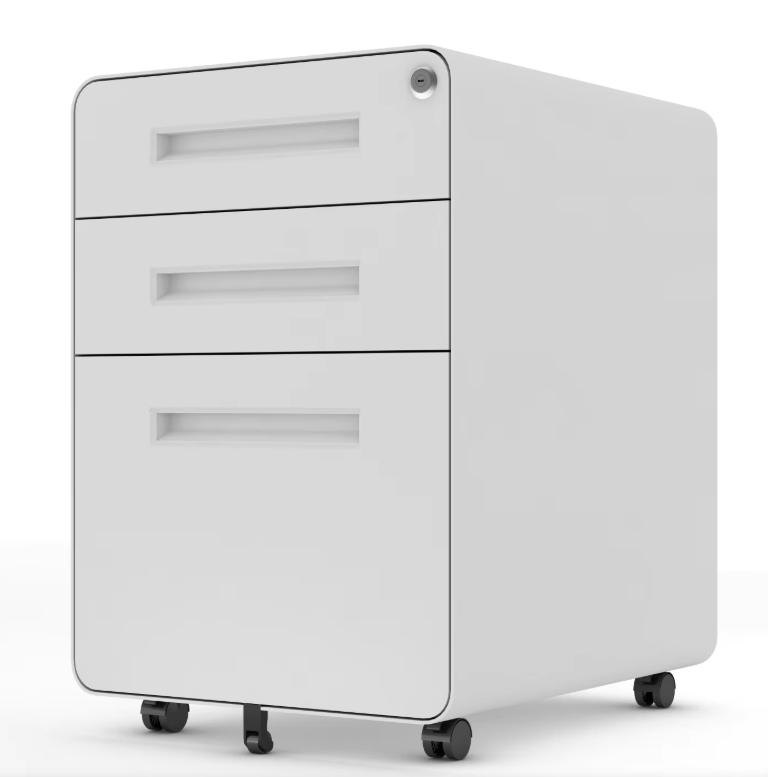
Core Construction: Heavy-Gauge Steel and Corrosion-Resistant Finishes
Steel Gauge Ratings, Welding Standards, and Load Capacity Benchmarks
Steel gauge directly determines load-bearing capacity for a lockable metal cabinet—lower gauge numbers indicate thicker, stronger steel. The table below summarizes typical industrial benchmarks for fully assembled cabinets with shelf spans under 900 mm:
| Steel Gauge | Nominal Thickness | Typical Distributed Shelf Load |
|---|---|---|
| 18 gauge | 1.2 mm | 180–250 kg |
| 16 gauge | 1.5 mm | 350–500 kg |
| 14 gauge | 2.0 mm | 600–900 kg |
These values assume continuous welded frames. Independent load tests in 2024 confirm similar performance for units built with full seam welds. Crucially, weld quality often matters more than gauge alone: continuous MIG or laser welds at corners and shelf supports significantly outperform intermittent spot welds under vibration and racking loads. Leading manufacturers align welding to AWS D1.1 or ISO 3834 process standards and proof-load test at 125% of rated capacity. Reinforced vertical channels and fully welded frames minimize side-wall deflection—preserving door alignment and lock engagement over years of use. For spans exceeding 900 mm, add internal stiffeners or derate capacity by 15–20%, per the 2023 structural review. Procurement teams should specify thickness tolerance of ±0.05 mm and request weld inspection reports for mission-critical applications. Heavy-gauge steel with full corner gussets further enhances resistance to forklift impact and stacking deformation.
Powder Coating, Galvanization, and Environmental Suitability by Industry Use Case
Finish selection must match operational conditions—not just aesthetics. Powder coating—typically epoxy-polyester or polyurethane—delivers a smooth, chip-resistant surface ideal for indoor warehousing, light manufacturing, and office storage. It resists mild chemicals and abrasion but can crack under tool impacts. For humid, outdoor, or washdown environments, hot-dip galvanizing or pre-painted galvanized steel (PPGI) offers superior corrosion protection: the zinc layer corrodes sacrificially before the underlying steel rusts. Hot-dip coatings typically measure 50–85 μm; epoxy-primed systems achieve over 500 hours of salt-spray resistance in 2024 coating performance tests. In food, medical, marine, and chemical settings, stainless steel—especially 316L grade with 2B, #4 brushed, or #8 mirror finishes—is preferred despite higher material cost. Carbon steel with zinc or zinc-aluminum alloy undercoats plus a powder topcoat provides a cost-effective middle ground for many B2B buyers.
Use the table below to match finish to exposure:
| Finish Type | Corrosion Resistance | Best-Fit Environments |
|---|---|---|
| Epoxy-polyester powder coat | Moderate | Dry indoor warehousing, light manufacturing |
| Hot-dip galvanizing or PPGI | High | Outdoor, coastal, humid, washdown |
| Stainless steel 2B or #4 brushed | Very high | Food, medical, marine, chemical |
For frequent washdowns, prioritize smooth, crevice-free surfaces to prevent bacterial harborage. Automotive parts storage may tolerate powder coat, while marine terminals and pharmaceutical cleanrooms demand 316L stainless or hot-dip galvanized bodies. Always verify that the specified finish meets ASTM B117 neutral salt spray or ISO 9227 requirements for your target site.
Security Performance: Locking Mechanisms and Tamper Resistance for Lockable Metal Cabinet Units
Mechanical vs. Electronic Locks: ANSI/BHMA Grade Compliance and Real-World Reliability
Mechanical locks remain widely used in lockable metal cabinets due to their simplicity and reliability—fewer electronic components mean fewer failure points. Buyers should verify that the lock complies with ANSI/BHMA (American National Standards Institute/Builders Hardware Manufacturers Association) grading: Grade 1 is engineered for high-frequency commercial use, while Grade 2 suits standard office and light industrial applications. A cabinet equipped with an ANSI/BHMA Grade 1 lock generally delivers superior resistance to picking, prying, and forced entry compared to ungraded hardware.
Electronic locks offer valuable features—including audit trails, keyless entry, and remote access—but real-world reliability hinges on power backup integrity, keypad or reader durability, and anti-drilling protection. In dusty or high-vibration environments, mechanical cylinders often outperform low-cost electronic keypads. For high-security storage, select electronic locks with recessed mounting, hardened steel backing plates, and tamper-evident override enclosures. Every system must include a mechanical override for power loss or electronic failure. Internally, multi-pin cylinders, disc tumblers, or encrypted electronic credentials provide stronger resistance to manipulation than basic mechanisms. Importantly, lock rating alone does not guarantee cabinet security—door gaps, hinge quality, and frame rigidity are equally critical.
Three-Point Locking, Multi-Point Latches, and Tamper-Resistant Hardware
Three-point locking secures the top, bottom, and side of the door, distributing force and reducing leverage available to prying tools. Multi-point latches engage at several locations along the frame, minimizing exploitable gaps. These mechanisms are most effective when paired with anti-pry returns, tight door-to-frame tolerances (≤1.5 mm), and concealed or protected hinges. Reinforced strike zones and internal fastener access prevent disassembly from outside the cabinet. Tamper-resistant hardware includes hardened steel plates around lock bodies, drill-resistant cores, and impact-resistant keypads or readers.
Some suppliers offer tamper alerts or door-open sensing—but these features complement rather than replace robust frame construction. In B2B sourcing, prioritize cabinets that maintain consistent structural resistance across doors, lock mounts, and frame junctions. Forced-entry testing should confirm the door withstands prying and kicking without bending enough to release the latch. While outdoor and high-traffic units benefit from weatherproofing and UV-resistant coatings, enclosure strength remains the primary line of defense. Always request evidence of third-party forced-entry certification for the entire cabinet assembly, not just the lock cylinder.
B2B Sourcing Strategy: Evaluating Manufacturers, Customization, and Supply Chain Fit
Strong sourcing for a lockable metal cabinet program begins with supplier audits—not pricing. Procurement teams should compare factory-direct lead times, warranty coverage, and customization capacity against total landed cost.
Verifying Manufacturer Credentials, Warranty Coverage, and Direct Factory Advantages
Supplier vetting must include third-party audit reports, ISO 9001:2015 certification, documented welding procedure specifications (WPS), and proof of structural load testing. Request a sample run or small pilot order to verify finish consistency, door alignment, and lock functionality under real-world handling. Warranty terms reveal long-term value: structural welds and locking hardware should carry multi-year coverage—not just cosmetic paint warranties. Direct factory sourcing can reduce unit cost by eliminating distributor markup, but confirm the plant owns its tooling and maintains scalable production capacity. Evaluate financial stability and shipping history—a supplier that passes quality audits but suffers chronic logistics delays introduces downstream risk. For larger programs, require a defined corrective action process and a named quality contact. This disciplined approach reduces hidden costs and strengthens long-term supply reliability.
Customization Options: Shelving, Access Control Integration, and USA-Made vs. Global Trade-offs
Customization starts with modular shelving: adjustable shelf clips, reinforced bottom shelves, and full-extension drawers accommodate diverse inventory profiles. For access control integration, verify the cabinet can accept electronic locks, remote release wiring, or badge reader brackets without compromising structural steel thickness—a common oversight in retrofit scenarios.
USA-made units often deliver shorter lead times, faster design iteration, and easier replacement-part access—but unit cost may be higher. Global sourcing can lower piece price, yet adds freight volatility, longer quality verification cycles, and communication friction. For high-security or time-sensitive deployments, domestic production supports responsiveness and traceability. For standard-duty storage, a qualified offshore manufacturer with stable documentation, ISO-certified processes, and proven compliance history can be highly practical. Build a balanced scorecard across price, lead time, customization depth, warranty, and logistics risk—the decision should reflect the value of the assets being secured, not just the cabinet’s sticker price.
FAQ
What steel gauge is ideal for industrial lockable metal cabinets?
Lower gauge numbers like 16-gauge (1.5 mm) or 14-gauge (2.0 mm) steel provide better load-bearing capacity, structural strength, and resistance against deformation.
What type of surface finish is best for humid or outdoor environments?
Hot-dip galvanizing or pre-painted galvanized steel offers high corrosion resistance and durability for humid or outdoor conditions.
Are electronic locks better than mechanical locks for security?
Electronic locks provide advanced features like keyless entry and audit trails, but mechanical locks often outperform them in dusty or high-vibration environments.
What is three-point locking and why is it important?
Three-point locking secures the top, bottom, and side of the cabinet door, providing greater resistance to prying and forced entry.
Should I prioritize domestic or international manufacturers for sourcing?
Domestic manufacturers may offer shorter lead times and better responsiveness, while qualified international manufacturers are practical for standard-duty storage needs depending on the logistical risk and cost.
Table of Contents
- Core Construction: Heavy-Gauge Steel and Corrosion-Resistant Finishes
- Security Performance: Locking Mechanisms and Tamper Resistance for Lockable Metal Cabinet Units
- B2B Sourcing Strategy: Evaluating Manufacturers, Customization, and Supply Chain Fit
-
FAQ
- What steel gauge is ideal for industrial lockable metal cabinets?
- What type of surface finish is best for humid or outdoor environments?
- Are electronic locks better than mechanical locks for security?
- What is three-point locking and why is it important?
- Should I prioritize domestic or international manufacturers for sourcing?