
 EN
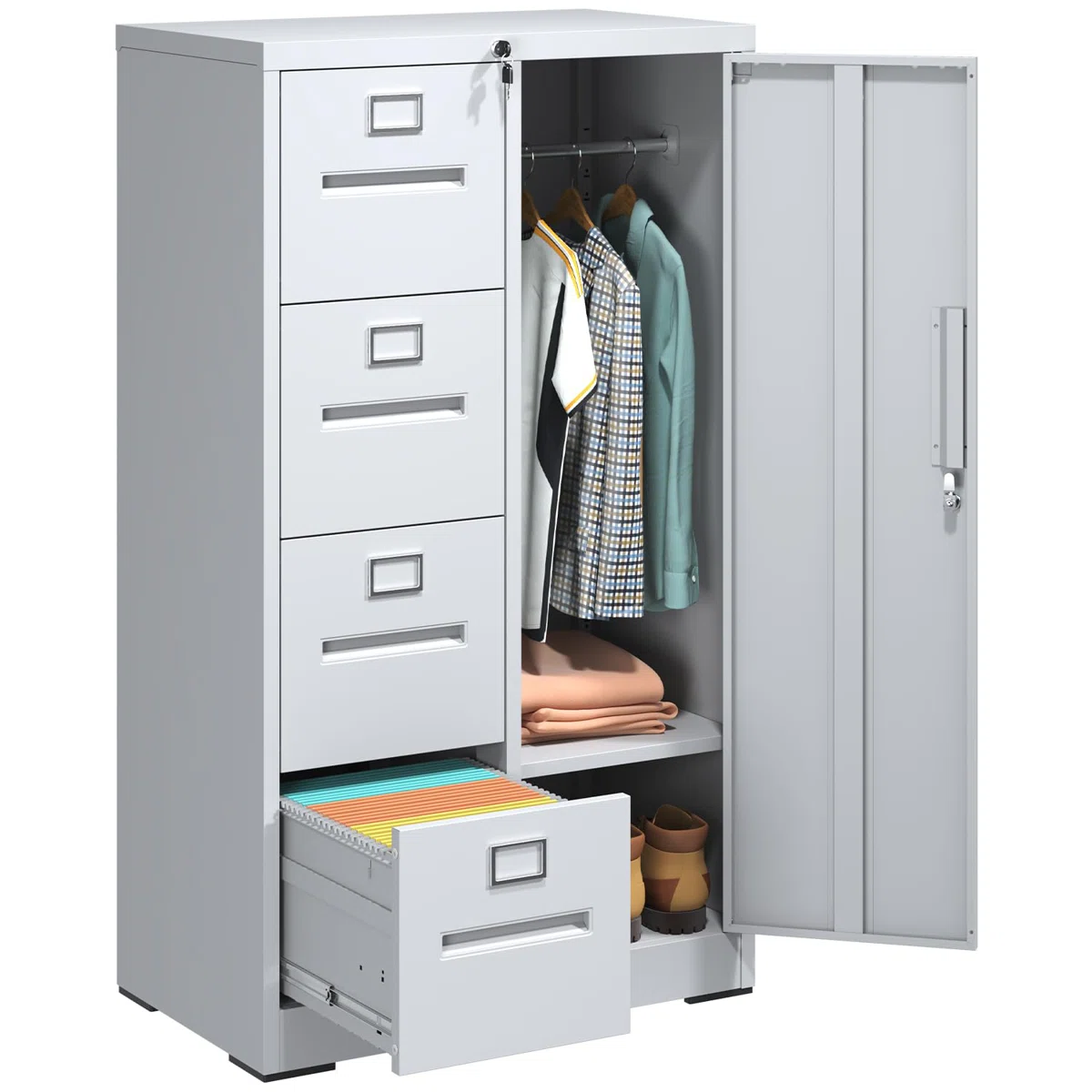
Core Structural Specifications of Industrial Storage Metal Cabinets
Steel Gauge Thickness, All-Welded Construction, and Load Capacity Standards
A correctly specified industrial storage metal cabinet begins with steel gauge and frame construction. Units are typically fabricated from 18-gauge to 20-gauge cold-rolled steel—lower gauge numbers indicate thicker, more dent- and deflection-resistant sheet metal. Fully welded frames—not bolted or riveted knock-down designs—are standard for high-cycle environments like manufacturing floors and warehouses. Reinforced corner welds, stiffened inner door panels, and heavy-duty leaf hinges distribute stress evenly and prevent racking under load.
Published static load ratings commonly range from 100 kg to 500 kg (220–1,100 lb) per shelf. A typical 72″H × 24″W × 36″D unit may be rated for up to 900 lb of evenly distributed weight. Procurement teams should request verified static load ratings for each shelf and total cabinet capacity, not just nominal values. Real-world performance is reduced by uneven point loads, pallet-jack impacts, or overhanging items—specify these use-case conditions before purchase. Note that gauge alone is insufficient: weld spacing, stiffener placement, and shelf thickness significantly influence structural integrity. For mission-critical applications, all-welded construction remains the authoritative benchmark per ANSI/BHMA A156.13 and ISO 13857 safety guidelines.
Welding Compliance (AWS D1.1, ISO 3834) and Load Testing Protocols
Welding quality is the primary differentiator between long-term industrial cabinets and light-duty alternatives. Structural welds must comply with AWS D1.1 Structural Welding Code – Steel, and fabricators should maintain ISO 3834 certification for fusion welding quality management. Buyers should verify documentation includes welder qualification records, procedure specifications (WPS), and material traceability.
Load testing protocols apply a static test load of 125% to 150% of rated shelf capacity for 24 hours, followed by measurement of permanent deformation, hinge misalignment, or weld cracking. Clarify whether reported capacities reflect single-shelf, fully loaded, or evenly distributed testing—only the latter reflects real-world usage. A compliant cabinet shows no visible weld separation, side panel buckling, or floor anchor failure. Incoming inspection should include dimensional verification, visual weld inspection per AWS D1.1 Appendix B, and review of third-party load-test certificates. For critical applications, specify nondestructive testing (NDT) such as dye penetrant or magnetic particle inspection on primary load-bearing joints—this mitigates risk of premature fatigue in high-use settings.
Security and Durability Features Critical for Enterprise Storage Metal Cabinets
High-Security Locking Systems, Tamper-Resistant Hasps, and Continuous Hinge Advantages
Enterprise-grade security requires integrated engineering—not add-on accessories. High-security locking systems should feature three-point or five-point latching that secures the top, bottom, and side of the door, distributing prying force and resisting forced entry far more effectively than single-point mechanisms. Select locks with drill-resistant cylinders and interchangeable cores certified to UL 437 or EN 1303 standards.
Tamper-resistant hasps—welded or deeply recessed—shield the shackle and mounting hardware from cutting tools and hammer attacks by eliminating exposed edges. Continuous hinges (piano or interlocking channel hinges) run the full door height and eliminate the narrow gaps found with standard butt hinges, making pry-bar insertion significantly harder. They also prevent door sag over time, maintaining latch alignment and seal integrity after years of repeated loading. For enterprise deployments, request hinge cycle-test data (minimum 100,000 cycles) and confirm hinge pins are made from stainless or hardened steel to resist wear and corrosion.
Total Cost of Ownership and Vendor Evaluation for Storage Metal Cabinet Procurement
Beyond Unit Price: Warranty Terms, Spare Parts Availability, and Lifecycle Maintenance Support
Acquisition cost often represents only one-third to one-half of total cost of ownership (TCO) over a 10-year duty cycle—per industry benchmarks from the National Association of Purchasing Management (NAPM) and recent facility lifecycle studies. The remainder stems from installation, maintenance labor, unplanned downtime, energy inefficiencies (e.g., poor seals increasing HVAC load), and end-of-life disposal.
Vendor evaluation must go beyond price. Prioritize warranty length, scope, and transferability: a five-year comprehensive warranty covering structural welds, powder-coat finish, and moving components signals confidence in durability. Avoid agreements that exclude hinges, locks, or shelf supports—these are the highest-failure items in daily use. Confirm whether warranties remain valid after relocation or reconfiguration.
Spare parts availability is equally critical. Request documented commitments for 10-year availability of locks, hinges, shelves, and gaskets—and verify regional inventory distribution. Vendors with dedicated parts logistics reduce mean time to repair (MTTR) and prevent costly workarounds. Lifecycle support should include touch-up coating kits, hinge adjustment services, and lock rekeying. Ask about multi-site service coverage and average lead times for replacement components. A preventive maintenance schedule—aligned with vendor recommendations—extends service life and helps maintain warranty validity.
| Cost element | Low-unit-price cabinet | Lifecycle-focused cabinet |
|---|---|---|
| Acquisition | Lower upfront | Slightly higher upfront |
| Warranty | 1–2 years, limited scope | 5–10 years, structural + finish coverage |
| Spare parts | Limited or generic substitutes | Guaranteed 10-year availability |
| Maintenance support | Buyer-managed, no SLA | Vendor-supported with defined response times |
| 10-year TCO | Often higher due to failures and downtime | Typically lower, with predictable budgeting |
Always ask vendors for TCO modeling—not just unit pricing—to enable apples-to-apples comparison.
Material Selection and Finish Options for Long-Term Performance of Storage Metal Cabinets
Carbon Steel, Stainless Steel, and Aluminum — Matching Corrosion Resistance to Environment and Use Case
Material selection must align corrosion resistance with environmental exposure—not just load requirements. Carbon steel offers the best strength-to-cost ratio but requires robust protection: a high-build, polyester-based powder coat (minimum 60–80 µm thickness) applied after thorough pretreatment (iron phosphate or zinc phosphating) ensures long-term resistance to oxidation, abrasion, and chemical splashes. It’s ideal for dry, climate-controlled interiors—offices, archives, and general-purpose warehouses.
Stainless steel provides inherent corrosion resistance without supplemental coating. Grade 304 is optimal for food processing, pharmaceutical cleanrooms, and humid indoor environments; grade 316—with added molybdenum—is required for chloride exposure (coastal facilities, labs using saline solutions, or wastewater treatment). Its passive oxide layer resists pitting and maintains hygiene compliance under frequent cleaning.
Aluminum (typically 5052 alloy) offers excellent atmospheric corrosion resistance and low weight—making it suitable for mobile units, cleanrooms, or installations where structural loading is secondary to weight constraints. While less rigid than steel, its natural oxide layer withstands mild alkaline cleaners better than carbon steel finishes. Avoid 6061 in marine or high-salinity settings due to lower chloride resistance.
Regardless of base material, finish specification matters: powder coating extends carbon steel service life, while passivation and electropolishing enhance stainless performance. Matching alloy, finish, and maintenance protocol to humidity, chemical exposure, cleaning frequency, and mechanical wear prevents premature degradation—and keeps TCO aligned with operational expectations.
FAQ Section
What steel gauge is recommended for industrial storage cabinets?
Industrial storage cabinets are typically fabricated from 18-gauge to 20-gauge cold-rolled steel, with lower gauge numbers offering thicker and more resistant sheet metal.
Why is all-welded construction preferred over bolted designs?
All-welded construction ensures higher durability and stress distribution, making it ideal for high-cycle environments like manufacturing floors and warehouses.
What should I consider when evaluating load capacity specifications?
Always request verified static load ratings for each shelf under evenly distributed weight. Include real-world usage conditions like uneven point loads and potential impacts during procurement.
How can I ensure secure storage in an enterprise setup?
Opt for cabinets with high-security locking systems featuring multi-point latches, drill-resistant cylinders, tamper-resistant hasps, and continuous hinges to maximize security and durability.
What materials are suitable for specific environments?
Carbon steel with powder coating is ideal for dry interiors, while stainless steel (grades 304 or 316) suits humid or chloride-laden environments. Aluminum works well for lightweight and cleanroom applications.
What factors influence total cost of ownership (TCO)?
TCO includes acquisition, warranty terms, spare parts availability, maintenance, and end-of-life disposal. Vendor support can significantly impact long-term costs.
Table of Contents
- Core Structural Specifications of Industrial Storage Metal Cabinets
- Security and Durability Features Critical for Enterprise Storage Metal Cabinets
- Total Cost of Ownership and Vendor Evaluation for Storage Metal Cabinet Procurement
- Material Selection and Finish Options for Long-Term Performance of Storage Metal Cabinets
-
FAQ Section
- What steel gauge is recommended for industrial storage cabinets?
- Why is all-welded construction preferred over bolted designs?
- What should I consider when evaluating load capacity specifications?
- How can I ensure secure storage in an enterprise setup?
- What materials are suitable for specific environments?
- What factors influence total cost of ownership (TCO)?