
 EN
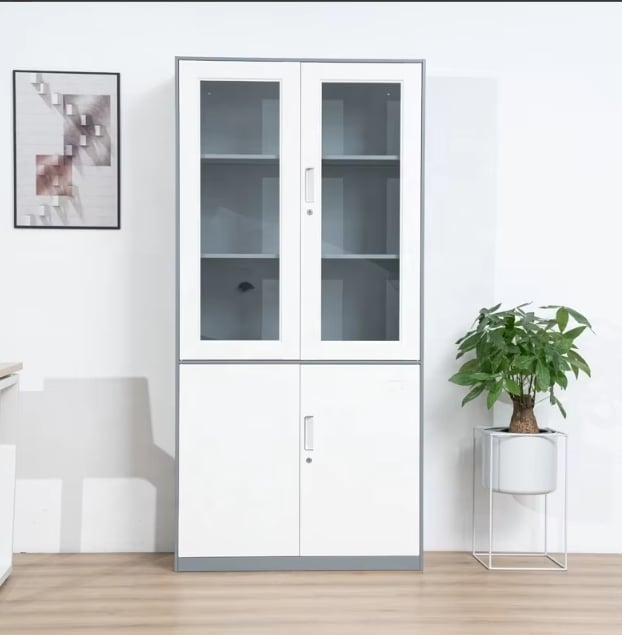
12–14 Gauge Steel Construction for Maximum Load-Bearing Integrity
How Thick-Gauge Steel Resists Deformation Under Static and Dynamic Loads
A heavy-duty locker cabinet built with 12–14 gauge steel resists deformation because lower gauge numbers indicate thicker sheet metal: 12-gauge measures 0.1046 inches (2.657 mm), while 14-gauge is 0.0747 inches (1.897 mm). This added thickness significantly increases section modulus and bending resistance—12-gauge steel is about 40% thicker than 14-gauge and more than twice as thick as common 18-gauge (0.0478 in / 1.214 mm). A thicker cross-section distributes point loads over a wider area, reducing peak stress at mounting holes and hinge brackets. Under static loads—such as stacked tools or heavy equipment—thicker panels flex less. Under dynamic loads—including door slams, body impacts, and floor vibrations—they absorb energy without denting or yielding. In contrast, 18-gauge cabinets often show permanent deformation at high-stress points within months of daily industrial use. For this reason, engineers routinely specify 12–14 gauge steel for structural frames, support rails, and high-traffic storage zones—directly influencing long-term door alignment, lock engagement, and dimensional stability.
Stress Test Comparison: 12-Gauge vs. 18-Gauge Steel in High-Traffic Locker Cabinet Installations
Standardized point-load and impact tests confirm measurable performance differences across gauges in real-world settings:
| Steel Gauge | Nominal Thickness | Static Load Deformation | Dynamic Impact Resistance | Typical High-Traffic Use |
|---|---|---|---|---|
| 12-gauge | 0.1046 in (2.657 mm) | Minimal under concentrated shelf loads | High; resists dents and door-slam fatigue | Industrial plants, central storage, tool cribs |
| 14-gauge | 0.0747 in (1.897 mm) | Low under distributed loads | Moderate; handles frequent use with lower impact force | Warehouses, maintenance shops |
| 18-gauge | 0.0478 in (1.214 mm) | Visible deformation at load points over time | Low; prone to hinge and latch misalignment after repeated slamming | Schools, labs, low-impact areas |
Thicker steel directly extends service life in high-traffic environments, where forces concentrate at door edges, strike plates, and shelf brackets. Maintenance teams consistently report fewer realignments, hinge replacements, and lock repairs in 12–14 gauge cabinets—making load-bearing integrity the foundational structural advantage of a durable storage system.
Welded Body Construction Ensures Long-Term Structural Rigidity
The structural reliability of a heavy-duty locker cabinet depends heavily on how its body panels and frame members are joined.
Spot Welding vs. Riveting: Impact on Tensile Strength and Fatigue Resistance in Locker Cabinets
Spot welding fuses base steel at localized points, creating a metallurgical bond without drilling holes. When properly executed, the weld nugget achieves tensile shear strength approaching that of the parent metal, enabling direct load transfer through the joint. Riveting, by contrast, removes material to accommodate fasteners—reducing net cross-sectional area and introducing stress concentrations at hole edges. Under repeated door slams and daily access cycles, riveted joints are susceptible to hole elongation and preload loss, degrading fatigue resistance over time. Spot welds eliminate these crack-initiation sites and maintain joint stiffness with minimal relative panel movement—preserving door-to-frame squareness and alignment throughout continuous use.
Why Continuous Welded Seams Minimize Vibration-Induced Loosening Over Time
Continuous welded seams integrate body panels into a single, monolithic structure—eliminating gaps where independent motion could occur. In environments near gym floors, production lines, or transit hubs, ambient vibration and impact cause micro-motion at mechanical joints. Each cycle gradually loosens fasteners and widens clearance holes. A continuous seam prevents this entirely: stress distributes along the full length rather than concentrating at discrete points. The result is sustained alignment, reduced rattling, and markedly lower risk of door sag or frame racking. Additionally, the sealed seam blocks moisture and debris from infiltrating joints—further protecting structural rigidity over the cabinet’s operational lifetime.
Three-Point Locking System Enhances Door-to-Frame Structural Cohesion
Mechanical Load Distribution Across Top, Middle, and Bottom Strike Points in Heavy Duty Locker Cabinets
A three-point locking system engages simultaneously at top, middle, and bottom strike points—spreading opening and closing forces across the full door height instead of concentrating them behind a single latch. When outward pressure is applied to a door corner, upper and lower rods keep the leaf seated, limiting leverage-induced bending of thin metal. The middle cam reinforces the zone most vulnerable to direct force during attempted entry. Because each point carries only a fraction of the total load, hinges, door skin, and frame experience less localized stress—significantly delaying warping, hinge creep, and loosening after repeated slamming. In high-traffic applications like schools, gyms, and industrial locker rooms, this balanced load path preserves door alignment, maintains consistent gasket compression, and supports long-term structural cohesion far more effectively than single-point mechanisms.
Precision Mortise-and-Tenon Joints Improve Frame Stability and Alignment Retention
In a heavy-duty locker cabinet, frame stability hinges on how well corner and rail connections resist racking, torsion, and repeated impact. Precision mortise-and-tenon joinery creates an interlocking mechanical bond: a precisely machined tenon on one frame member fits snugly into a matching mortise on the adjacent piece. This design distributes shear and tensile forces across a much larger contact surface than screws, rivets, or butt joints. Independent testing shows mortise-and-tenon assemblies withstand approximately 3,500 lb of force before failure—more than three times the capacity of typical butt joints (Fine Woodworking). They also resist racking up to 10× better than screw-only connections. For cabinets subjected to door slams, shifting contents, and uneven floor loading, this strength keeps the frame square and doors aligned—even under years of daily use.
Alignment retention stems directly from the geometry: mortise walls fully surround the tenon, physically constraining movement out of square under cyclic load. Screw- or rivet-only joints rely solely on clamping force—which diminishes as vibration works through the structure. The inherent interlock of mortise-and-tenon minimizes creep and play, preventing the small cumulative shifts that lead to binding doors, inconsistent gaps, and latch misalignment. Over time, this precision-fit construction sustains consistent door-to-frame alignment without requiring frequent adjustment.
Continuous Door Strike Design Maintains Warping Resistance and Seal Integrity
A continuous door strike replaces traditional short strike plates with a full-height channel that engages the entire latch edge of the door. This design spreads closing and locking force evenly across the frame—rather than concentrating it at two or three discrete points. As a result, the door leaf resists twisting and sagging under repeated use, and the cabinet maintains uniform gasket compression around its full perimeter. Industry fabrication guidance for sealed enclosures emphasizes that reliable sealing depends on stable flange alignment and consistent closure distance. With a continuous strike, the door returns to the exact same closed position every time—reducing stress on hinges, welds, and gaskets. This consistency prevents warping along the seal line and ensures long-term protection against dust, moisture, and unauthorized access.
FAQ
What is the difference between 12-gauge and 14-gauge steel?
The primary difference is the thickness of the steel. 12-gauge steel measures 0.1046 inches (2.657 mm), while 14-gauge steel is thinner at 0.0747 inches (1.897 mm). Thicker steel offers greater load-bearing integrity and deformation resistance.
Why are spot welds preferred over rivets in locker cabinets?
Spot welding creates a stronger metallurgical bond without the need for holes, minimizing stress concentrations and reducing material weakening that is common with riveted joints. This ensures better fatigue resistance and structural rigidity over time.
How does a three-point locking system improve durability?
Three-point locking systems evenly distribute stress across the top, middle, and bottom strike points, reducing localized deformation and prolonging the structural integrity of hinges and doors.
How does mortise-and-tenon construction benefit locker cabinets?
This high-strength joinery method improves frame stability by distributing forces evenly across interlocking pieces, minimizing movement and maintaining door alignment even under daily use.
What advantages does a continuous door strike provide?
Continuous door strikes improve sealing integrity and prevent warping by uniformly distributing locking and closing forces across the entire door edge, maintaining gasket compression and alignment.
Table of Contents
- 12–14 Gauge Steel Construction for Maximum Load-Bearing Integrity
- Welded Body Construction Ensures Long-Term Structural Rigidity
- Three-Point Locking System Enhances Door-to-Frame Structural Cohesion
- Precision Mortise-and-Tenon Joints Improve Frame Stability and Alignment Retention
- Continuous Door Strike Design Maintains Warping Resistance and Seal Integrity
- FAQ