
 EN
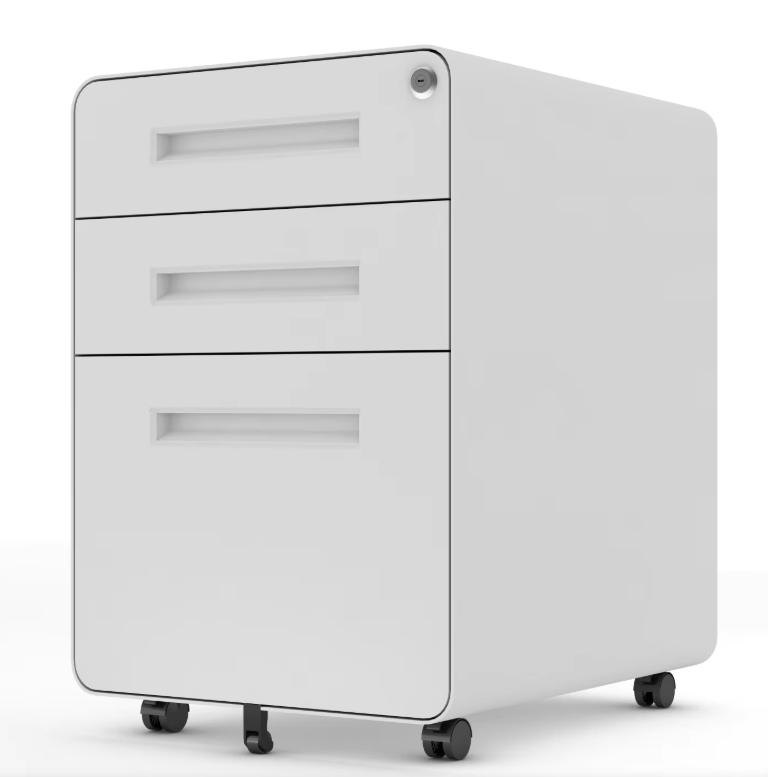
Core B2B Procurement Criteria for Vertical Cabinet with Drawers
Drawer Count, Capacity, and Material Trade-Offs Across Budget Tiers
When specifying a vertical cabinet with drawers, procurement teams must weigh drawer count, internal capacity, and material gauge against total cost. Most commercial buyers select four-drawer units because they balance floor footprint and filing capacity; three- and five-drawer versions suit high-density or low-clearance spaces. Depths typically range from 25 to 28 inches, while widths of 12, 15, and 18 inches determine whether letter- or legal-size folders fit without jamming. Two-drawer compact cabinets are common for satellite workstations, but they reduce usable filing inches per floor area.
Economy tiers use thinner cold-rolled steel and basic paint finishes—acceptable for low-traffic records but prone to denting. Mid-range models add powder-coated steel, heavier gauge panels, and reinforced drawer bases, often rated for 50–75 lb per drawer. Premium tiers use double-wall construction and full-extension suspension, supporting 100 lb or more per drawer with smoother cycling. The trade-off is not linear: a five-drawer premium cabinet may occupy less floor area than two separate three-drawer value units, but its upfront cost can be 40–60% higher. Buyers should compare cost per usable filing inch—not per drawer—to make objective value assessments.
Lock Security, Mobility, and Assembly Complexity in Commercial Deployments
Lock security, mobility, and assembly complexity directly affect total cost of ownership in commercial deployments. Central locking mechanisms that secure all drawers with one key reduce administrative burden, but most value models use single-drawer locks—less convenient for shared file rooms. High-security options include recessed cam locks and anti-tip interlock systems, which are essential for HR, legal, or medical records.
Mobility is a trade-off: caster-equipped units simplify reconfiguration, yet fully loaded drawers make them top-heavy. Locking casters or floor anchors are strongly recommended. Assembly complexity also varies—ready-to-assemble models can require 45–90 minutes per unit, adding hidden labor costs in multi-unit deployments. Fully welded or pre-assembled cabinets typically cost 10–20% more but reduce setup time and rework. For facilities with tight timelines, procurement should compare delivered-and-installed pricing—not just unit price. Specifying a standard removable lock core across multiple cabinets cuts key management complexity, while avoiding proprietary locks reduces rekeying costs over the asset’s lifecycle.
Space-Smart Sizing and Configuration of Vertical Cabinet with Drawers
Selecting the right vertical cabinet with drawers starts with matching footprint to document format and install path.
2–5 Drawer Systems: Depth, Width, and Document Compatibility (Letter vs. Legal)
For two-drawer configurations, common footprints range from 14.3 to 24.1 inches wide and 18.9 to 24 inches deep. A powder-coated steel model measuring 15.75 × 20 × 24 inches supports either letter (8.5 × 11 in) or legal (8.5 × 14 in) files, while a 24.1 × 14.3 × 18.9 inch metal unit typically supports letter-only storage.
| Configuration | Common Width | Common Depth | Document Compatibility |
|---|---|---|---|
| 2-drawer compact | 14.3–18 in | 18.9–24 in | Letter only |
| 2-drawer standard | 15.75–24.1 in | 20–24 in | Letter or legal |
| 3- to 5-drawer | 15–20 in | 18–24 in | Letter or legal |
In three- and four-drawer systems, depth stays 18–24 inches, but height increases by roughly 10–12 inches per additional drawer. Width remains narrow—often under 20 inches—to preserve aisle clearance. Procurement teams should confirm internal drawer width, not just cabinet width: letter-size hanging files need about 12.5 inches clear width, while legal-size folders need at least 15.5 inches. Material trade-offs also affect weight: steel drawer cabinets can weigh 60–90 lb, so floor loading and castor selection matter in multi-level buildings.
Measuring for Tight Corridors, Under-Desk Zones, and Wall-Niche Installations
Before ordering a vertical cabinet with drawers, measure the full travel path—not just the final location. Doorways, elevators, and stair landings often have 32–36 inch clearance; a cabinet wider than 30 inches may require unpacking or a split-delivery plan. For under-desk placement, verify knee space and drawer extension: fully extended drawers can add 14–20 inches beyond the closed depth, so a 20-inch-deep cabinet may require 34–40 inches of clear floor area. Wall niches should allow at least 1 inch side clearance for ventilation and cleaning, plus 3 inches rear clearance for wall baseboards or uneven plaster. Check floor flatness: a slope greater than 1/4 inch per 10 feet can cause drawer drift on non-locking casters. Finally, mark door swing arcs and personnel movement lanes; compact 15.75-inch-wide cabinets improve corridor flow in tight offices.
Durability Engineering: Drawer Mechanisms and Construction Standards for Vertical Cabinet with Drawers
Suspension Systems, Thumblatches, and Follower Blocks for 10,000+ Cycle Reliability
In a commercial vertical cabinet with drawers, suspension hardware determines how well drawers tolerate daily load cycles. Full-extension ball-bearing slides support easier access and reduce lateral stress, while soft-close or self-closing tracks limit slamming. Thumblatches add secure closure without protruding handles, and follower blocks keep hanging files upright under repeated movement. Procurement teams should specify drawer slides tested to at least 10,000 open/close cycles, with zinc-plated or stainless steel components for humidity resistance. Tool-free component replacement features further reduce downtime when hardware eventually wears. Suppliers that document cycle tests and provide replacement kits simplify long-term asset management.
Face Frame vs. Frameless Construction and Hardware Grade Impact on Long-Term Stability
Face-frame cabinets use a front frame for structural rigidity and easier drawer alignment. Frameless designs rely on thicker panels and precision drilling, often maximizing drawer width in compact vertical layouts. Hardware grade then becomes the stability lever: Grade 1 hinges, steel drawer slides, and reinforced corner brackets reduce racking. For procurement, match the chosen frame style to expected load and mobility demands—because lower hardware grades can undermine even the strongest panel construction over time.
Certifications, Use-Case Alignment, and Value Benchmarking for Vertical Cabinet with Drawers
Procurement teams should treat certifications as baseline filters, not premium add-ons, when selecting a vertical cabinet with drawers. Drawer slides should meet ANSI/BHMA A156.13 Grade 1—the American National Standards Institute / Builders Hardware Manufacturers Association standard designed for 50,000+ open-close cycles at rated load. Fully extending, ball-bearing slides rated for at least 45 kg per drawer—not per cabinet—are the practical minimum for commercial use. Tall cabinets with a height-to-width ratio above 3:1 should include seismic anchoring hardware tested to CABO/ICC-ES AC156. This is a code requirement in California, Oregon, and Washington, and a best practice elsewhere.
Use-case alignment often decides whether the cabinet performs well after installation. Legal and HR teams typically need legal-size drawers, follower blocks, and full-extension access. Maintenance, Repair, and Operations (MRO) teams need deeper drawers rated for dense tool or parts storage. If workers must walk, bend, and search manually, labor cost can exceed the unit price over five years. In larger deployments, once a facility prices 10 to 15 drawer cabinets, comparing that investment with automated storage and retrieval may reveal a smaller total cost gap than expected.
A value benchmark should measure cost per drawer cycle and floor space per drawer—not just invoice price. For shelving, welded steel supports outperform stamped brackets by 3–5× in deflection resistance over a decade of continuous loading.
| Benchmark factor | Minimum commercial threshold | Value impact |
|---|---|---|
| Drawer slide cycle rating | 50,000+ cycles at rated load | Reduces replacement and downtime |
| Per-drawer load rating | 45 kg or more | Prevents sag and drawer slide failure |
| Seismic anchoring | CABO/ICC-ES AC156 for tall units | Code compliance and tipping prevention |
| Retrieval workflow | Full-extension, ergonomic access | Cuts labor time and injury risk |
Suppliers that document these thresholds make total cost of ownership easier to compare across bids.
Frequently Asked Questions
What factors should be considered before buying a vertical cabinet with drawers?
Consider the number of drawers, their capacity, material construction, assembly complexity, lock security, mobility features like casters, standard removable lock cores for key management, and certifications for durability standards.
Which configuration is best for tight office spaces?
Compact two-drawer configurations are optimal for tight spaces or under-desk zones due to their narrow width and reduced footprint. Ensure proper measurements for full extension and clearances before installation.
What are the key features for durability in drawer mechanisms?
Look for full-extension ball-bearing slides, soft-close or self-closing tracks, thumblatches for secure closure, and follower blocks. Hardware should meet at least 10,000 cycle reliability testing with corrosion-resistant materials like zinc-plated or stainless steel.
How important are certifications for vertical cabinets?
Certifications like ANSI/BHMA A156.13 Grade 1 guarantee durability and reliability for high-load environments, ensuring the cabinet can support heavy use. Additional requirements, such as seismic anchoring for tall cabinets, may be necessary for certain locations.
Is it better to buy ready-to-assemble cabinets or pre-assembled ones?
Ready-to-assemble cabinets are cost-effective but involve higher labor costs due to assembly time. Pre-assembled or fully welded units reduce installation time and costs but are priced higher upfront. The decision depends on your facility’s deployment needs.
Table of Contents
- Core B2B Procurement Criteria for Vertical Cabinet with Drawers
- Space-Smart Sizing and Configuration of Vertical Cabinet with Drawers
- Durability Engineering: Drawer Mechanisms and Construction Standards for Vertical Cabinet with Drawers
- Certifications, Use-Case Alignment, and Value Benchmarking for Vertical Cabinet with Drawers
-
Frequently Asked Questions
- What factors should be considered before buying a vertical cabinet with drawers?
- Which configuration is best for tight office spaces?
- What are the key features for durability in drawer mechanisms?
- How important are certifications for vertical cabinets?
- Is it better to buy ready-to-assemble cabinets or pre-assembled ones?