
 EN
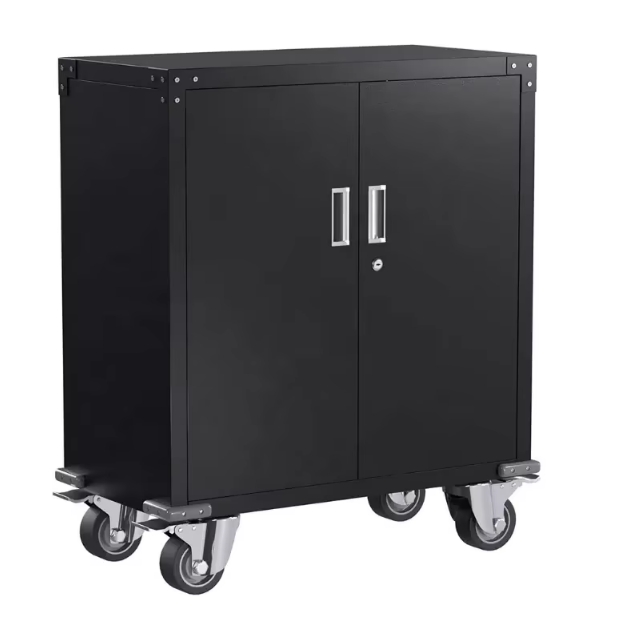
The bottom drawer of a mobile file cabinet in a county records room had started to droop. Staff had packed it with case files until, at full extension, the front dipped at one corner and a gap opened along the top edge. The frame leaned toward the open side. A straightedge across the top showed one side panel bowing near the slide channel, and light under the base hinted the bottom was no longer square. The check moved from the slide to the plate behind it, then to the crossmember below and the brake on each caster. The fault was structural, not cosmetic.
On a Fully Loaded Drawer: A Field Observation
Where the Drawer Face First Shows a Gap
A loaded drawer behaves as a cantilever. Its weight plus the folders acts forward of the cabinet body, so the slide and panel carry a bending moment that grows as the drawer travels. The first sign is rarely a broken part. A gap opens along the upper edge of the drawer front, wider at the free corner, because the side panel flexes where the slide mounts. For a mobile file cabinet carrying dense archives, that gap is the earliest signal that something is undersized.
Measuring Sag with a Straightedge and Feeler Gauge
Diagnosis stayed low tech. The lead set a straightedge across the cabinet top, closed the drawer, and sighted the reveal at both corners. A feeler gauge gave a repeatable reading, taken again with the drawer empty to separate permanent set from elastic flex. Pressing the outer corner at full extension showed how much droop came from the slide versus the frame. Repeating this on an identical mobile file cabinet in the same row confirmed the fault was unit specific, not a batch problem.
Why Loaded Drawers Pull Frames Out of Square
What a Ball-Bearing Slide Carries Versus a Roller Slide
A ball-bearing slide spreads the drawer load along a hardened race, so the balls share vertical force across a long contact line instead of a few rollers. That matters most at full extension, where a cheaper roller slide deflects and lets the front tip. Rated travel and the mounting method decide how much force reaches the steel. When a mobile file cabinet is specified for dense archives, the slide sets how a packed drawer behaves and deserves a line of its own in any order.
Caster Brakes Do Not Stop Frame Racking
A locking caster holds a cabinet still on the floor, yet it does nothing to keep the box above it square. Racking is a distortion of the frame, a shift from rectangle toward parallelogram driven by uneven load and repeated side force. The brake addresses floor movement, not the twisting of welded panels. Every caster brake engaged cleanly and the cabinet still leaned. Specifying a mobile file cabinet by its casters alone will not stop that lean; resistance belongs in the crossmembers and welded joints.
Reinforcement Plates Transfer Load into the Cabinet Frame
The Bottom Crossmember That Ties Both Side Panels
The bottom crossmember keeps the two side panels acting as one box. In a mobile file cabinet the base does more than hold drawers, because it resists one side spreading outward when a loaded drawer pulls the opposite rail. Without it, the base becomes a loose U shape and the slide mounts work against each other, showing up as the widening top gap seen on site. A welded member tied into both sides and the back closes that section. Stiffening it changed how the whole mobile file cabinet reacted to the open drawer.
How Spot Welding and Bending Share the Load
Cold-rolled steel sheet becomes a stiff structure only after cutting, bending and joining. A CNC bending operation folds a flange along the panel edge, adding far more rigidity than flat sheet, like a crease in paper. Spot welding locks those folds to the reinforcement plate and crossmember at repeated points, spreading stress across the joint. A local plate behind the slide mount gives fasteners something to bite into. A Luoyang factory founded in 1992, covering 30,000 square meters with a monthly output of 10,000 pcs, relies on this sequence to keep each mobile file cabinet consistent.
Standards, Load Paths, and Long-Term Care
More Reliable Than a Visual Guess: What the Standards Require
A straightedge reading describes one cabinet; a standard describes what any cabinet should survive. ANSI/BIFMA X5.9 sets strength and durability expectations for storage units, the closest reference for drawer sag, slide cycling and frame stability. ISO 9001 sits behind the process side, since repeatable bending, welding and coating depend on a managed quality system. OSHA 1910.176 speaks to secure storage so a loaded unit does not tip in a busy aisle. NFPA 101 keeps circulation clear, because a cabinet in an escape path is a life safety problem. For a buyer comparing one mobile file cabinet with another, these references become purchase order checks.
Buying a mobile file cabinet: ask for the slide type, rated travel and side panel gauge in writing, and request a drawing showing the reinforcement plate behind each slide mount and the crossmember under the base. A supplier describing formed and welded construction gives a load path that can be checked later.
Inspecting a mobile file cabinet on arrival: set the unit on a level floor, engage every caster brake, open each drawer fully and sight the reveal at both top corners with a straightedge. Press the outer corner of a loaded drawer and watch the side panel. Confirm welds are continuous at the base corners.
Using a mobile file cabinet: distribute weight toward the lower drawers first, avoid leaving a fully packed drawer open, and move the cabinet only after the brakes are released and drawers closed. Keep the load within rated travel and never use an open drawer as a step or shelf.
Maintaining a mobile file cabinet: wipe the slide races clean, check that mounting bolts stay tight, and measure the top reveal every few months on heavily used units. A growing gap is an early warning. Level the feet again or replace a worn caster before frame distortion becomes permanent.
Frequently Asked Questions
Q: What causes a fully loaded drawer to sag?
A: A loaded drawer acts as a cantilever, so the folders create a bending moment that grows as the drawer extends. The slide, the mounting plate behind it and the side panel all flex a little under that force. When any is undersized, the front dips at the free corner and a gap opens along the top edge. Checking each part separately shows where the deflection begins.
Q: How does a ball-bearing slide help with heavy files?
A: A ball-bearing slide spreads vertical load along a hardened race, so many balls share the force instead of a few rollers carrying it at single points. That wider contact line reduces deflection at full extension, where the lever arm is longest. The slide still needs a stiff mounting plate and a sound side panel, because it can only pass load into the steel supporting it.
Q: Do locking casters prevent a cabinet frame from twisting?
A: No. A locking caster stops the cabinet rolling across the floor, but it does not resist racking, which is the frame shifting from a rectangle toward a parallelogram under uneven side load. That resistance comes from welded joints, reinforcement plates and a bottom crossmember tying the side panels together. Casters matter for stability and safe positioning, yet they address floor movement, not the geometry of the box.
Q: Why is a bottom crossmember important on a mobile unit?
A: The bottom crossmember ties both side panels into a single closed section, so a loaded drawer pulling on one rail cannot spread the base into a loose U shape. Without it, slide mounts work against each other and the frame racks, showing up as a widening gap at the drawer top. A welded member joined to the sides and back keeps slide alignment stable over years of daily use.
Q: Which standards apply to drawer strength and storage safety?
A: ANSI/BIFMA X5.9 covers strength and durability for storage units, so it is the main reference for drawer sag, slide cycling and frame stability. ISO 9001 supports the process side, since repeatable forming and welding depend on a managed quality system. OSHA 1910.176 addresses secure storage so a loaded unit does not tip or shed contents. NFPA 101 protects the surrounding escape path.
Q: How often should drawer alignment be checked?
A: On a heavily used cabinet, measure the top reveal of each drawer every few months with a straightedge and note any change. A gap that grows between readings means a slide, a bolt or the frame is slowly giving way, and it is easier to correct early than after a weld cracks. Wipe the races, retighten fasteners and replace a worn caster during the same visit.