
 EN
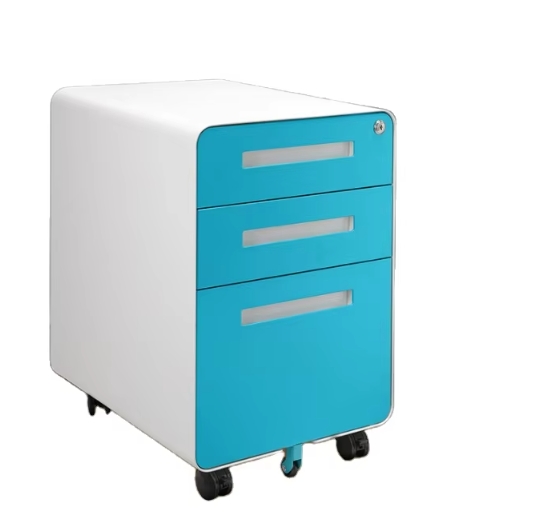
An archive room tells a sourcing team more than a catalogue does. A buyer walks a row of steel units, pulls a loaded drawer toward its stop and watches the cabinet shift on its casters. On a hard floor, a unit without a locking caster creeps, and with the drawer fully extended the weight moves forward until the base can rock. For a steel mobile file cabinet, the choice is less about finish than about what happens under a full drawer. Casters, anti-tip geometry and ball-bearing slides set the terms.
The Archive Walk-Through: Where Casters Decide The Order
Reading The Floor Before Reading The Brochure
On a sourcing visit to a records room, the useful evidence is on the floor: scuff marks where units drift and a gap behind a cabinet that has crept out of line. Luoyang Huawei Office Furniture, founded in 1992 and working across 30,000 square meters with a monthly output of 10,000 pcs, was the first in its local industry to offer mail order packing and to pass a third-party factory audit, and it builds a steel mobile file cabinet for such floors.
On The Spec Sheet: Casters, Slides And Center Wheels
A spec sheet for such a unit should name the caster type, the brake mechanism and the slide rating. Locking casters hold the unit still while a drawer is opened; ball-bearing drawer slides keep a full drawer travelling smoothly; a center wheel adds a support point that resists the forward pitch. Anti-tip behaviour depends on that geometry. A knock-down, or KD, structure with bolts and reinforcement ribs keeps the base square.
What Does A Loaded Drawer Do To A Cabinet On Wheels?
More Drawer Travel, More Forward Load
Pull a loaded drawer out and the centre of gravity walks forward with it. On a unit with only corner casters, the front wheels become a pivot and the cabinet can pitch. A tipping unit can strike a clerk, block an aisle, or shear a caster plate loose from the base. OSHA 29 CFR 1910.176 addresses material storage and securing against tipping, and NFPA 101 keeps exit routes clear. Sourcing without testing that extended-drawer condition leaves the main failure mode unexamined.
Why A Creeping Cabinet Costs More Than A Brake
The damage from an under-specified unit appears slowly. Casters develop flat spots, brakes lose grip, and the bolts of a KD frame work loose. Ball-bearing slides begin to sag and the drawer no longer closes flush. Once an archive team anchors a row of units to the floor to stop the movement, the mobility that justified the purchase is gone. A unit chosen on finish alone tends to reach that point; one chosen on caster specification does not.
The Physics Behind A Cabinet That Refuses To Tip
How A Center Wheel Changes The Support Polygon
Stability is geometry. A cabinet on corner casters has a support polygon that ends at those wheels; extend a heavy drawer and the centre of mass can pass beyond it. A center wheel placed near the front adds support ahead of the pivot, so the load stays inside the base. A ball-bearing drawer slide carries the extension without twisting the frame. That is how a steel mobile file cabinet resists the condition the archive visit exposed.
Why Anchoring Is A Last Resort, Not A Feature
A stable unit starts with the steel. Cold-rolled steel sheet cut on laser cutting and hydraulic punching machines, bent to shape and spot welded, is degreased and phosphated before electrostatic powder coating. That sequence, checked by coating adhesion and salt spray tests, decides how the base resists scuffs from grit under the casters. KD bolts and leveling feet let a technician square the frame. Anchoring the unit to a wall is a last resort, not a design feature; the goal is a base that stays put on its own.
Anchors, Aisles And The Standards Behind The Purchase
Standards That Frame An Archive-Room Order
An archive-room tender usually names several families of references. ANSI/BIFMA X5.9 covers storage unit strength and durability, and ANSI Z535.4 covers the safety labels on a braked unit. ISO 9001 frames a quality management system, ISO 14001 addresses environmental management, and ISO 45001 addresses occupational health and safety. OSHA 29 CFR 1910.176 addresses material storage and securing against tipping, while OSHA 29 CFR 1910.37 covers egress routes. NFPA 101, the Life Safety Code, sets requirements for exit width and clear aisles, and NFPA 1 is the Fire Code.
Buying a steel mobile file cabinet: ask for the caster type and brake rating, the ball-bearing drawer slide load, and the position of the center wheel, all stated for a fully loaded drawer. Confirm the unit is a knock-down structure with listed bolts and reinforcement ribs. Check that safety labels under ANSI Z535.4 are supplied and that the supplier accepts custom orders per customer plan or sample. Ask whether spare casters, slides and brakes are stocked for later replacement.
Inspecting each unit on arrival: set every locking caster brake and push the cabinet sideways to confirm it holds on the actual floor, then open a fully loaded drawer to its stop and watch for rocking or creep. Check that the center wheel sits in contact with the floor. Cycle each ball-bearing drawer slide for smooth travel, and look for racking in the KD frame by sighting the drawer gaps. Verify the leveling feet can be adjusted and that the powder-coated finish is even.
Using the cabinet day to day: set the brakes before pulling any drawer, especially on a polished floor, and open a single loaded drawer at a time so the tipping moment stays inside the base. Keep the heaviest files in the lowest drawer. Train records staff to close drawers fully before moving, because a cabinet pushed with a drawer out is the condition the sourcing test was meant to catch.
Maintaining the fleet over time: check caster brakes, wheel treads and center wheel contact on a regular pass, and clear grit from the wheels because embedded debris causes the creeping a locking caster is meant to stop. Re-torque the bolts of the KD frame and the caster plates, and re-level the unit. Lubricate or replace ball-bearing drawer slides that begin to sag. Log any unit that still rocks under a full drawer so the anti-tip geometry can be reviewed.
Frequently Asked Questions
Q: What decides the order in an archive-room purchase?
A: Usually it is the loaded-drawer test rather than the finish or the panel gauge. A buyer pulls a full drawer to its stop and watches whether the cabinet creeps, rocks or holds. Locking casters, a center wheel and a rigid KD base decide that result, along with a ball-bearing drawer slide that carries the load without twisting the frame. A mobile file cabinet that stays planted under that condition wins the order, because it addresses the failure the room presents.
Q: Why does a locking caster matter more than wheel size?
A: A larger wheel rolls easily, but without a brake the cabinet drifts when a drawer is pulled. A locking caster fixes the unit to the floor during the forward load, so drawer travel does not become cabinet travel. Combined with a center wheel and a braked swivel, it keeps the support polygon under the centre of mass. For a mobile file cabinet on a hard polished floor, the brake is what converts a rolling unit into a stable workstation.
Q: How does a center wheel prevent tipping?
A: A center wheel adds a support point near the front of the base. When a loaded drawer extends, the centre of mass moves forward; without that wheel the front casters become a pivot and the cabinet can pitch. With it, the load stays inside the support polygon and the base resists the forward moment. On a steel mobile file cabinet, that extra contact often separates a stable unit from one that rocks under a full drawer.
Q: Should an anti-tip unit be anchored to the floor?
A: Anchoring is a fallback, not the design goal, because a mobile file cabinet is bought to move and bolting it down removes that feature. A rigid KD base, locking casters, a center wheel and a drawer interlock that keeps a single drawer open bound the tipping moment without a fixed anchor. Anchoring is sensible only where a risk review demands it; NFPA 101 still requires clear aisle and exit width. Test the extended-drawer condition before deciding.
Q: Which standards apply to a sourcing tender like this?
A: ANSI/BIFMA X5.9 covers storage unit strength and durability, including loaded drawer and slide cycling, and ANSI Z535.4 covers product safety labels. ISO 9001 frames the quality system, ISO 14001 covers environmental management, and ISO 45001 covers occupational safety. OSHA 29 CFR 1910.176 addresses material storage and anti-tip securing, while OSHA 29 CFR 1910.37 covers egress routes. NFPA 101 is the Life Safety Code and NFPA 1 is the Fire Code.
Q: What should a buyer check on the first delivery?
A: Set the brakes and pull a fully loaded drawer to its stop, watching for creep, rocking or a lifting front caster. Confirm the center wheel contacts the floor and each ball-bearing drawer slide closes flush. Sight the KD frame for racking and adjust the leveling feet. Match delivered casters, slides and brakes to the tender part references so later spares fit. A steel mobile file cabinet that passes this loaded-drawer check is the unit worth repeating.