
 EN
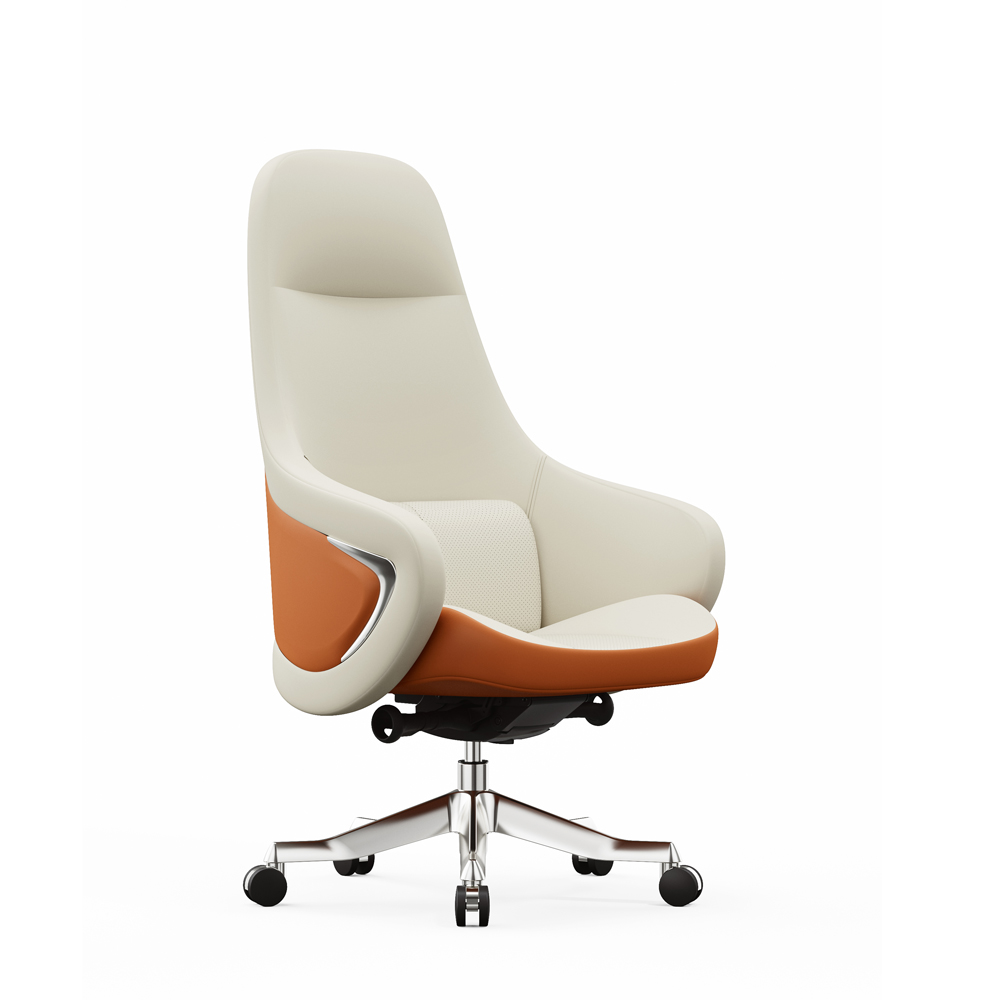
Five-Point Base Geometry for Superior Stability and Load Distribution
The base of a heavy-duty office chair is not a cosmetic shell; it is the primary load path. A five-point design widens the support polygon and spreads forces before they reach casters or structural joints.
How symmetrical five-point design prevents uneven stress on casters and joints
A symmetrical five-point base places each leg 72 degrees apart from the next. This radial layout gives the central column multiple transfer paths when weight shifts during swivel, roll, or recline—distributing dynamic force across adjacent legs instead of overloading a single rear caster. Repeated off-center loads in mobile office chairs create micro-bending at caster stems and hub welds. With five equally spaced legs, no single stem remains under peak stress for long; the load cycles through different casters as the user moves, reducing fatigue unevenness. As a result, joints stay tighter, casters wear at similar rates, and rolling resistance remains predictable—the mechanical balance that makes five-point geometry the enduring standard for high-capacity seating.
ANSI/BIFMA X5.1 tipping threshold data: 5-point vs. 4-point bases in real-world mobile office chair use
ANSI/BIFMA X5.1-2017 stability testing evaluates office chairs under a 225 lb (102 kg) seat load with horizontal forces applied to the backrest and seat edges. A five-point base changes the failure mode: the rear support boundary moves closer to the applied force, requiring greater horizontal displacement before any caster lifts. In side-load tests, a five-point design keeps more casters grounded than a four-point base at the same tip angle. That larger support polygon translates into a higher force threshold before rollover begins. Real-world mobility—rapid swivels, reaching, and lateral shifts—places critical demand on stability precisely when a four-point base would unload one rear wheel; the fifth leg provides essential reserve stability at that moment.
High-Load Structural Integrity: Materials, Certification, and Long-Term Durability
UL 902 certification benchmarks: 350+ lb rated frames versus standard 250-lb mobile office chairs
UL 902 certification requires heavy-duty mobile office chairs with 350+ lb rated frames to pass static load, drop, and cyclic fatigue tests far exceeding those for standard 250-lb chairs. Independent testing shows UL 902–certified frames sustain 300 lb dynamic loads for 100,000 cycles without joint loosening, while many standard units develop caster wobble after just 30,000 cycles. The higher rating reflects tangible engineering differences: thicker steel or reinforced composite seat plates, stronger welds, and larger-diameter gas lift pistons. In practice, this means reduced seat pan flex under shifting weight, stable cylinder alignment, and lower long-term repair frequency—critical advantages for users above 250 lb or those sitting extended hours. UL 902 also informs warranty terms and institutional procurement standards, making it the most defensible structural benchmark for high-use applications.
Reinforced nylon composites vs. stamped steel — fatigue resistance under daily mobility cycles
Reinforced nylon composite bases and stamped steel bases respond differently to daily mobility cycles. Composites absorb vibration and dampen caster chatter but require thick, strategically placed ribs to prevent stress cracks near caster sockets. Stamped steel offers higher stiffness but transmits shock and shows fatigue at welded joints. Fatigue testing reveals reinforced nylon composites retain 90% of their flexural modulus after 80,000 swivel-roll cycles, whereas stamped steel bases develop micro-fractures around caster plates under identical loading. Because daily mobility amplifies tensile and compressive forces at the hub, leading heavy-duty designs combine a steel-reinforced nylon hub with a composite star base—balancing crack resistance, energy absorption, and dimensional stability to reduce sudden caster socket failure. Both materials demand precise hub tolerances to prevent loosening over time.
Center-of-Gravity Optimization for Dynamic Mobility and Tipping Resistance
Low-CoG engineering in heavy duty mobile office chairs: Swivel-roll kinematics and lateral torque reduction
Lowering the center of gravity (CoG) shortens the lever arm between occupant mass and the caster contact patch—a key principle in heavy-duty mobile office chair design. This geometry reduces lateral torque during swivel-roll movements, where rotation and translation occur simultaneously. A lower CoG keeps the resultant force vector within the five-point stability polygon during rapid direction changes, minimizing the risk of caster lift. Per ANSI/BIFMA X5.1 stability protocols, lowering seat-pan height by 10–15% can reduce lateral tip force by up to 20% in dynamic swivel sequences. Accordingly, top-tier heavy-duty models integrate the gas lift, mechanism box, and reinforced base plate closer to the floor. This low-CoG architecture enhances anti-tipping capability without compromising smooth, controlled motion—even under sustained 350 lb loads.
Integrated Mobility Systems: Casters, Swivel Mechanism, and Floor Adaptability
Dual-density caster design for seamless carpet-to-hard-floor transitions without compromising base structural integrity
A heavy-duty mobile office chair must roll smoothly across mixed flooring while preserving structural integrity. Dual-density casters achieve this by combining a firm core for load support with a softer outer tread for grip and floor protection. On low-pile carpet, the wider contact patch lowers rolling resistance; on hardwood or tile, the polyurethane or rubberized outer layer prevents scratches and improves traction. Crucially, inconsistent wheel materials can transmit lateral forces upward into the base—dual-density wheels absorb micro-impacts and vibration before they reach caster stems and joints, protecting the five-point base’s structural integrity. Paired with a precision 360-degree swivel mechanism, this design ensures smooth directional changes. For optimal performance, match caster type to floor surface—soft, wide wheels for carpet; rubberized treads for hard floors—and confirm caster capacity aligns with the chair’s certified weight rating to avoid wobble and joint fatigue.
FAQ
Why is a five-point base superior to other designs?
A five-point base provides improved stability and load distribution thanks to its wider support polygon. It reduces stress concentration on casters and joints, leading to enhanced durability and balance.
What does UL 902 certification signify?
UL 902 certification indicates heavy-duty office chairs have passed stringent tests, including static load, drop, and cyclic fatigue assessments, proving their ability to handle 350+ lb loads under prolonged use.
How does lowering the center of gravity improve chair stability?
Lowering the center of gravity shortens the lever arm between occupant mass and the caster contact area, reducing lateral torque during movements and minimizing tipping risks.
What are dual-density casters, and why are they beneficial?
Dual-density casters combine firm cores for load support and soft outer treads for floor grip. They provide smooth rolling performance across various flooring surfaces while minimizing structural stress on the chair's base.
Table of Contents
- Five-Point Base Geometry for Superior Stability and Load Distribution
- High-Load Structural Integrity: Materials, Certification, and Long-Term Durability
- Center-of-Gravity Optimization for Dynamic Mobility and Tipping Resistance
- Integrated Mobility Systems: Casters, Swivel Mechanism, and Floor Adaptability
- FAQ