
 EN
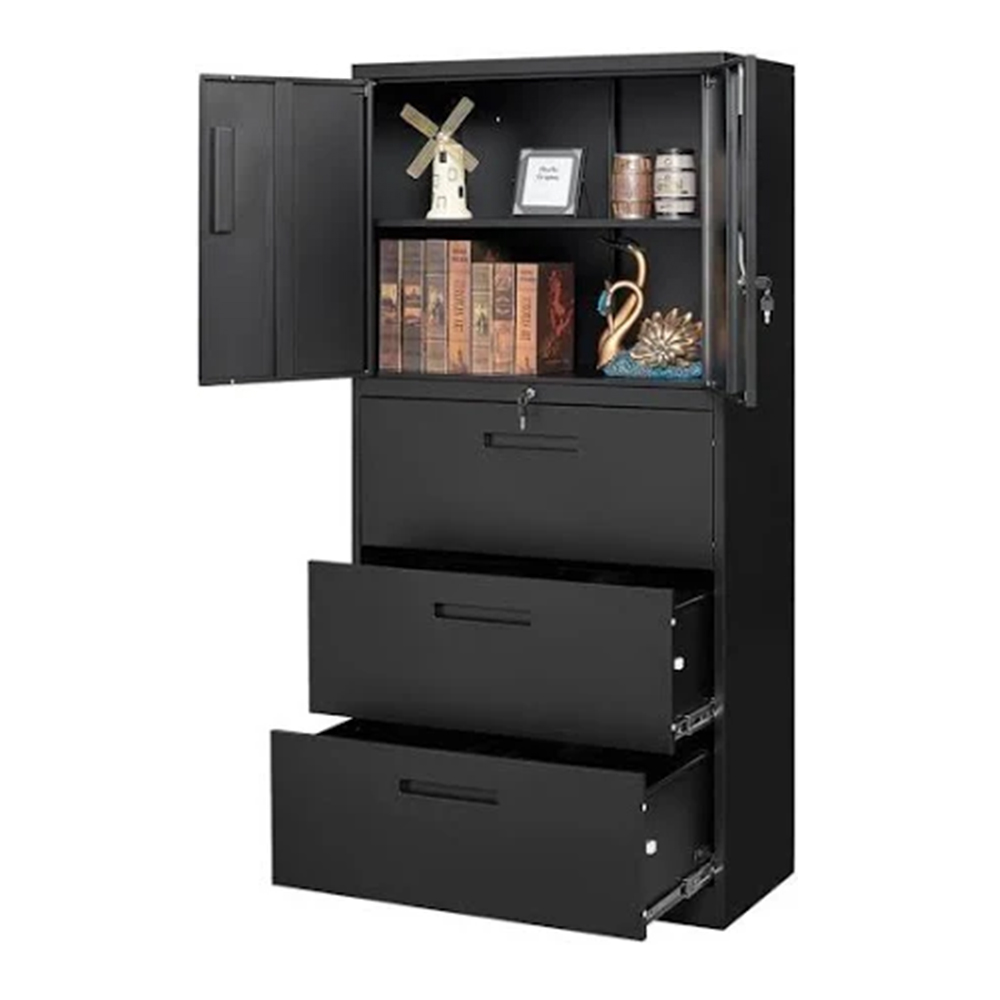
Reinforced Steel Framework for Exceptional Load-Bearing Capacity
A steel mobile cabinet’s frame determines how much weight it can hold without sagging, twisting, or permanent deformation. Two key design features separate heavy-duty units from standard storage cabinets: material thickness and joint reinforcement.
How 14-Gauge Cold-Rolled Steel Doubles Static Load Limits vs. Standard Cabinets
14-gauge cold-rolled steel measures approximately 0.0747 inches thick—nearly 56% thicker than the 18-gauge sheet (0.0478 inches) commonly used in standard cabinets. Because bending stiffness scales with the cube of thickness, this increase delivers significantly higher resistance to deflection before weld and geometry effects are considered. Per ANSI/BIFMA X5.9-2019 static load testing, a heavy-duty steel mobile cabinet built with 14-gauge cold-rolled steel frames typically supports 1,200 lbs per unit without permanent set—double the 600-lb capacity of comparable 18-gauge units. While stiffness alone would suggest a greater advantage, other components—slides, casters, and welds—become limiting factors at higher loads. Cold-rolled steel also offers tighter thickness tolerances and a smoother surface, promoting uniform load distribution across shelf supports and panel joints. This consistency reduces localized yielding and extends fatigue life across repeated loading cycles.
The Role of Gusseted Corner Welds in Distributing Dynamic Load During Movement
Gusseted corner welds reinforce the critical junction where vertical side panels meet base and top rails. Rather than relying on a single fillet weld at a sharp 90-degree corner, a gusset plate extends the weld path and redirects stress away from the high-concentration zone. This is essential during movement: rolling across thresholds or uneven floors induces racking and torsional forces that concentrate at frame corners. Following AWS D1.1/D1.1M:2020 prequalified joint guidance, the added weld length and optimized gusset geometry increase effective throat area and moment-resisting section—reducing peak stress and delaying fatigue onset. In practice, gusseted corners maintain frame alignment over time, preserve door and drawer clearances, and prevent diagonal deformation. They ensure the load path remains intact from shelf to caster—not just when stationary, but while actively moving under full load.
Engineered Mobility: Casters and Chassis Designed for Stability Under Load
Stability under load—especially during movement—is non-negotiable for industrial-grade steel mobile cabinets. Caster mounting method and wheel engineering directly influence lateral control, vibration damping, and long-term chassis integrity.
Dual-Point Mounting System vs. Bolt-On Caster Designs in Steel Mobile Cabinet Applications
A dual-point mounting system secures each caster at two distinct chassis locations, distributing load across a broader section of the lower frame. In contrast, bolt-on casters attach through a single top plate, concentrating force around four or six fasteners. That concentration invites point loading, fastener loosening, and progressive frame twist—especially when wheels strike floor joints or transitions.
| Factor | Dual-Point Mounting | Bolt-On Caster |
|---|---|---|
| Load path | Distributed across two chassis points | Concentrated at one top plate |
| Racking resistance | High—paired points resist twisting | Moderate—depends on fastener torque |
| Frame stress | Lower peak stress at each mount | Higher peak stress around bolt holes |
During loaded movement, dual-point mounts keep the caster stem vertically aligned, preserving swivel responsiveness and preventing drift. They also reduce chassis wear by spreading peak stress across two reinforced mounting pads instead of one stamped plate—maintaining squareness and alignment over years of dynamic use.
Why 5-Inch Polyurethane Dual-Wheel Casters Support 1,200 lbs Per Unit
Five-inch wheels lower rolling resistance compared to smaller diameters, reducing push/pull effort and improving start-stop control. Polyurethane treads resist compression better than rubber, maintaining consistent contact pressure and minimizing energy loss. The dual-wheel configuration splits weight across two contact patches per caster—halving unit pressure on each wheel and protecting both floor surfaces and caster bearings. Combined, these features enable a verified 1,200-lb rated load per cabinet (with four casters installed). Wider tread surfaces further enhance tracking accuracy, keeping the cabinet rolling straight rather than wandering. Under lateral forces, polyurethane’s elastic recovery maintains chassis levelness without cracking—making this configuration ideal for tool storage, machine-side staging, and maintenance carts handling heavy steel components.
Impact-Resistant, Warp-Proof Panel Design for Long-Term Reliability
Ribbed Front and Side Panels Reduce Deflection by 42% (ASTM F2057-22 Testing Data)
Ribbed front and side panels deliver measurable improvements in impact resistance and dimensional stability. ASTM F2057-22 structural loading tests show ribbed profiles reduce panel deflection by 42% compared to flat-sheet equivalents, without increasing material gauge. The raised ribs act as integral stiffeners—resisting bending, twisting, and oil-canning by redirecting stress along defined load paths. This rigidity preserves door squareness, drawer tracking, and weld seam integrity—even after years of workshop impacts and shifting loads. For mobile applications, it means fewer hinge adjustments, less paint cracking, and sustained alignment during frequent repositioning. Ultimately, geometric reinforcement—not just heavier steel—ensures long-term reliability and protects stored contents.
Modular Interlocking Structure Ensures Decade-Long Dimensional Stability
Precision-Punched Mounting Holes and T-Slot Alignment Eliminate Frame Drift Over 10+ Years
Precision-punched mounting holes and integrated T-slot rails transform assembly into a repeatable, high-fidelity process. Each panel locks into fixed reference points—eliminating lateral shift and rotational play that degrade alignment over time. Unlike field-drilled or slotted systems, pre-punched holes ensure fasteners seat consistently, preserving initial frame geometry. T-slot rails guide vertical and horizontal members into precise registration, preventing cumulative drift across repeated load cycles and reconfigurations. This modular interlocking structure maintains square shelf openings, aligned drawer slides, and continuous load paths—supporting daily movement, heavy use, and future expansion. As a result, the cabinet retains its original dimensional stability for more than a decade with minimal maintenance.
Corrosion-Resistant Structural Continuity From Frame to Finish
Zinc-Primed Steel Substrate + Powder-Coated Exterior: How Layered Protection Preserves Load Path Integrity
Corrosion compromises structural continuity at microscopic seams—especially weld zones where stress concentrates and cross-sectional thickness is most critical. A heavy-duty steel mobile cabinet combats this with a two-stage protective system: a zinc-rich primer applied over the entire steel substrate, followed by a thermoset powder-coated exterior. The zinc primer acts as a sacrificial anode, corroding preferentially to protect underlying steel and sealing weld junctions where failure risk is highest. The powder coat adds a hard, non-porous barrier resistant to scratches, humidity, and cleaning chemicals. Together, they preserve material thickness at gusseted corners, mounting brackets, and frame interfaces—ensuring the cabinet sustains its rated load-bearing capacity over time. In accelerated salt-spray testing per ASTM B117-19, zinc-primed and powder-coated panels show no red rust after 1,000 hours, while bare steel exhibits visible corrosion within 120 hours. This layered defense maintains structural integrity from top frame to bottom chassis—critical for durability in workshops, garages, and industrial environments.
FAQs
What is the benefit of using 14-gauge steel in a steel mobile cabinet?
14-gauge steel is significantly thicker than 18-gauge steel, offering higher bending stiffness, greater load-bearing capacity, and improved fatigue resistance under heavy use.
Why are gusseted corner welds important in steel mobile cabinets?
Gusseted corner welds enhance the structural integrity of frame corners, distributing stress more effectively during movement and preventing deformation under heavy loads.
How does the dual-point caster mounting system improve mobility?
The dual-point mounting system distributes load across two chassis points, reducing frame stress, improving racking resistance, and ensuring long-term durability during dynamic use.
Why are ribbed panels used in cabinet design?
Ribbed panels reduce deflection and add impact resistance, preserving the cabinet’s structural integrity over years of use.
How does the zinc-primer and powder-coat system prevent corrosion?
The zinc-rich primer and powder-coating work together to create a layered protective barrier that prevents weld zone corrosion and extends the cabinet’s lifespan.
Table of Contents
- Reinforced Steel Framework for Exceptional Load-Bearing Capacity
- Engineered Mobility: Casters and Chassis Designed for Stability Under Load
- Impact-Resistant, Warp-Proof Panel Design for Long-Term Reliability
- Modular Interlocking Structure Ensures Decade-Long Dimensional Stability
- Corrosion-Resistant Structural Continuity From Frame to Finish
-
FAQs
- What is the benefit of using 14-gauge steel in a steel mobile cabinet?
- Why are gusseted corner welds important in steel mobile cabinets?
- How does the dual-point caster mounting system improve mobility?
- Why are ribbed panels used in cabinet design?
- How does the zinc-primer and powder-coat system prevent corrosion?