
 EN
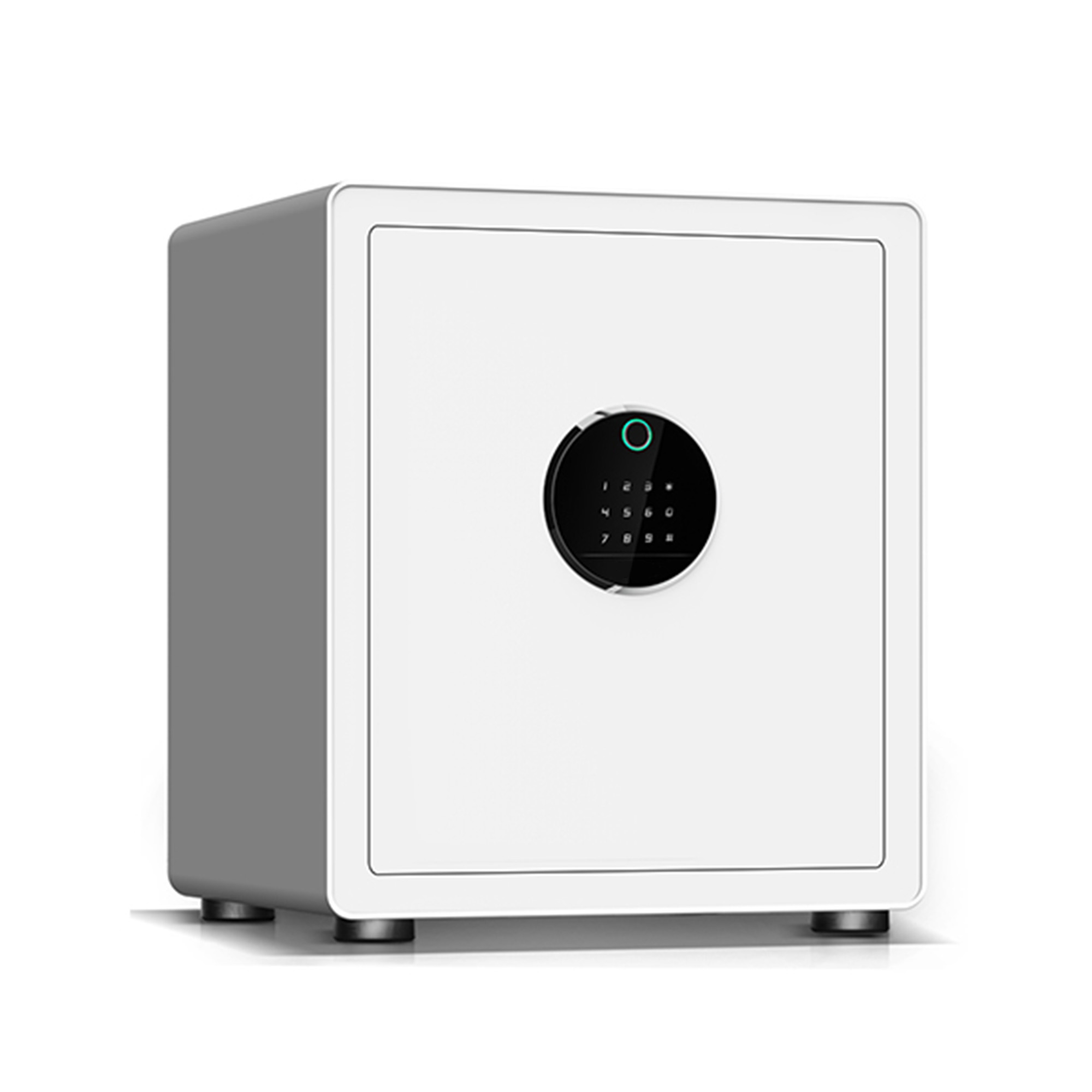
Reinforced Steel Construction for Superior Impact Resistance
A heavy-duty storage safe earns its rating long before the lock engages. The body must resist blunt force, ballistic threats, and accidental drops without losing structural integrity.
Multi-layered steel plating with ASTM-certified tensile strength
A storage safe designed for impact resistance rarely uses a single steel plate. Instead, manufacturers layer materials to force an attack through different hardness levels: a cold-rolled outer layer, a hardened intermediate plate, and a ductile inner liner. This arrangement interrupts stress waves because each layer deforms at a different rate. ASTM tensile certification verifies that the steel meets documented yield and ultimate tensile strength values—such as ASTM A36’s minimum 36,000 psi yield and 58,000 psi tensile strength (ASTM 2023). Higher-strength grades can exceed 80,000 psi tensile strength for high-risk applications. The layered design also limits crack propagation: a blow that cracks the outer layer may not breach the inner liner, preserving door closure. Corners and door frames receive additional plate thickness to reduce weak points. This combination of certified steel and multi-layer construction enables a heavy-duty storage safe to absorb repeated sledgehammer strikes without opening.
Ballistic and drop-test validation per UL 1037 certification
Impact resistance must be proven under controlled attack scenarios. UL 1037 certification provides a recognized benchmark for testing a storage safe against forced entry and physical abuse. During ballistic validation, technicians fire common handgun and rifle cartridges at close range into the safe body; the steel must stop penetration or limit deformation to a specified depth. Drop-test protocols then lift a loaded safe and release it onto concrete from several feet—simulating a fall during handling or an attack intended to dislodge the unit. After each test, inspectors verify door alignment, locking bolt travel, and weld integrity. A heavy-duty safe that passes these tests keeps the door locked and the body intact even after severe impact. By contrast, a standard security cabinet may dent, crack, or spring open under the same conditions. UL 1037 certification, especially under the 2023 test revisions, requires whole-safe testing—not just sample-panel approval—giving buyers stronger confidence that the storage safe will perform in real-world break-in attempts.
Engineered Bolt-Down System to Prevent Theft by Displacement
Integrated anchor points rated for ≥12,000-lb pull resistance on concrete
A storage safe is only as secure as its attachment to the structure around it. Integrated anchor points on this model are reinforced to withstand pull forces greater than 12,000 lb on standard 3,000 psi concrete, following ASTM E488 anchor testing methods (2021). That rating means a thief cannot simply rock the safe loose or use a pry bar to shift it toward a dolly. The system includes two or more hardened steel anchor sleeves molded into the safe floor, allowing lag shields or expansion bolts to bite into the slab without compromising the fire seal. During displacement attacks, force transfers from the pry point into the concrete—not the safe body—reducing peak stress on the door frame. Installers are advised to verify slab thickness and cure time before drilling, because anchor capacity drops significantly on cracked or low-strength concrete. Even partial pullout failure leaves the safe tilted and blocked by surrounding fixtures, making rapid removal far less likely.
Pry-Resistant Interlocking Door Frame Design
360° continuous weld seam and recessed hinge geometry
A pry-resistant storage safe relies on the junction between the door edge and the safe body. Economy-grade units often use spot welds or interlocking seams, which leave small gaps where a crowbar can gain purchase. Heavy-duty models eliminate these weak points with a 360° continuous weld seam around the entire internal door frame. This unbroken weld path distributes prying force across the full perimeter, so no single point becomes a stress riser. The weld is typically ground flush after fabrication, removing any exposed bead that a prying tool could shear. Recessed hinge geometry adds a second layer of defense: instead of sitting proud of the door edge, the hinge leaves are set behind the door face, making direct hammering or pin removal impractical. The door edge also overlaps the frame with minimal clearance—often below 0.06 inch—blocking flat-bar insertion. Together, these features turn the door and frame into one continuous structural unit, ensuring pry attempts are absorbed, not concentrated.
Pry-force comparison: heavy-duty vs. standard storage safe (NIST SP 1000-22)
Standard storage safes often fail at visible mechanical joints. Under NIST SP 1000-22 (2022) testing principles, prying force is applied until a 0.25-inch opening forms at the door-to-frame gap. In standard designs with spot-welded corners and exposed hinge pins, this gap opens at relatively low force because the prying tool concentrates stress on a single weld or hinge bearing. Heavy-duty units with continuous weld seams and recessed hinges resist the same prying force two to four times longer before reaching the same opening threshold. The table below summarizes the key contrast:
| Attack metric | Standard storage safe | Heavy-duty storage safe |
|---|---|---|
| Door-to-frame seam | Spot welds or interlocking seams | 360° continuous weld |
| Hinge exposure | Surface-mounted pins | Recessed behind door edge |
| Typical pry-force threshold | Lower; corner or hinge failure first | 2–4× higher; uniform panel flexure without gap |
| Most common failure mode | Hinge pin shear or corner split | Localized deformation without entry |
Fire-Rated Insulation for Dual-Threat Protection in a Storage Safe
A heavy-duty storage safe must resist both forced entry and fire. UL 72 Class 350 certification tests whether internal temperature stays below 350°F (177°C) for at least 60 minutes while exterior temperatures reach 1200°F (649°C)—protecting paper documents, cash, and essential records from charring.
Ceramic fiber + intumescent composite matrix (UL 72 Class 350, 60+ min at 1200°F)
The fire barrier relies on two materials. Ceramic fiber slows heat transfer through the walls and door. Intumescent composite expands when heated, sealing gaps to block hot gases and smoke. Together, they form a passive thermal shield that maintains cooler interior air even as the outer shell heats. Some designs also pass explosion and drop tests after fire exposure—verifying that the safe remains closed and insulation stays intact. For business owners and homeowners, this dual-layer approach reduces the chance that a fire turns a break-in-resistant storage safe into an oven. When evaluating models, look for UL 72 Class 350 labeling—not vague “fireproof” claims—because certification confirms the insulation will perform under controlled, repeatable fire conditions.
FAQ
What is the ASTM certification, and why does it matter for storage safes?
ASTM certification ensures that the steel used in storage safes meets verified yield and tensile strength standards, which are crucial for resisting impact and forced entry attempts.
What does UL 1037 certification include?
UL 1037 certification tests heavy-duty storage safes for resistance to ballistic threats and drop impacts under controlled scenarios to verify structural integrity and locking mechanisms.
What is the significance of a continuous weld seam?
A 360-degree continuous weld seam strengthens the door frame, distributing prying force evenly to prevent gaps or entry under stress.
Why is fire-rated insulation important in storage safes?
Fire-rated insulation, such as ceramic fiber and intumescent composite, ensures that the contents inside the safe remain protected against fire and heat damage, even at extremely high external temperatures.