
 EN
Compartment Dimensions and Capacity Planning for a Single Locker for Sale
When comparing any single locker for sale, start with compartment dimensions—they determine whether laptops, helmets, coats, and work boots will fit comfortably without forcing users to cram or bend items.
Standard vs. User-Centric Sizing: Ensuring Fit for Laptops, Helmets, and Coats
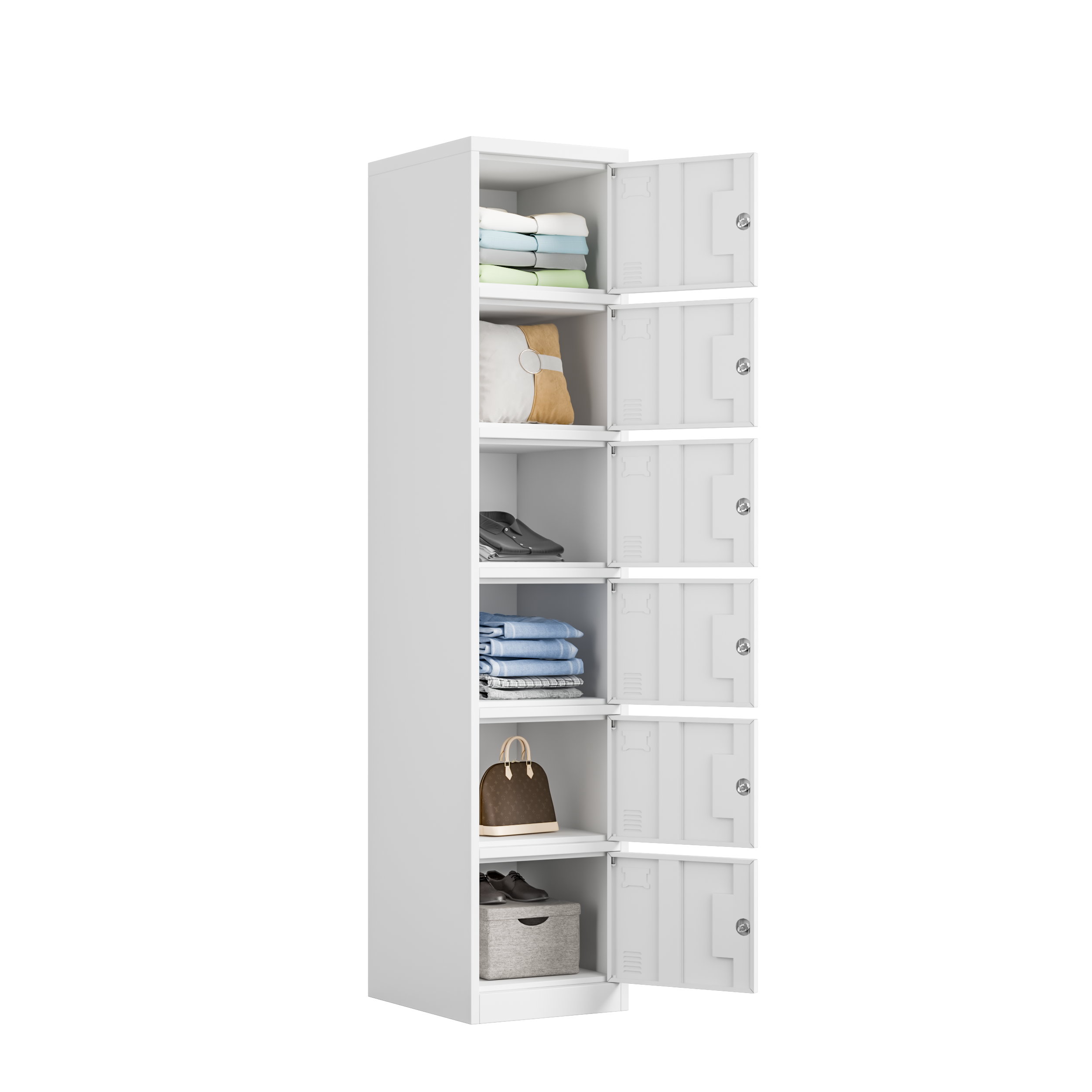
Standard single locker dimensions vary widely. Compact personal units may measure 35 cm (13.8 in) wide, 46 cm (18.1 in) deep, and 185.5 cm (73 in) tall, while institutional full-height models typically range from 15–18 in wide, 15–21 in deep, and 78 in tall. A single locker with one full-height door provides the full internal height to one user—ideal for hanging garments and bulky gear.
| Storage profile | Typical width | Typical depth | Typical height | Best fit |
|---|---|---|---|---|
| Compact personal single locker | 35 cm (13.8 in) | 46 cm (18.1 in) | 185.5 cm (73 in) | Laptops, bags, light coats |
| Institutional full-height single locker | 15–18 in | 15–21 in | 78 in | Helmets, work boots, full-length coats |
| Counter-height cabinet | 36 in | 18 in | 42 in | Small daily-use items |
User-centric sizing adds at least 2–3 inches of clearance around the largest stored item and accounts for door swing and hardware protrusion. Before ordering, verify available width, height, depth, walkway space, and ceiling height—not just nominal dimensions.
Interior Layout, Ventilation, and Compliance with ADA/OSHA Space Requirements
Interior layout should avoid protruding hooks or sharp edges that can snag or damage garments. Perforated doors, side vents, or top louvers reduce moisture and odor buildup—especially critical for damp coats, helmets, and work boots. In humid or high-activity environments, perforated steel doors offer superior airflow and durability.
For ADA compliance, at least 5% of each locker type—or one unit if fewer—must be accessible, with a minimum 30 × 48 in clear floor space and operable hardware within reachable ranges (ADA Standards for Accessible Design, §206.3). Under OSHA guidelines, lockers must be securely anchored, feature raised legs for cleaning access, and eliminate exposed sharp edges or pinch points on doors and frames. Sloped tops or seamless end panels further simplify maintenance and reduce dust accumulation.
Locking Mechanism Reliability and Access Control Options
Key, Combination, and Electronic Locks: MTBF, Failure Rates, and Maintenance Burden
Locking mechanism reliability directly affects total cost of ownership. Mechanical keyed cam locks are simple but carry the highest administrative burden: lost or duplicated keys often require full cylinder replacement or rekeying, and key tracking introduces overhead. Facility maintenance benchmarks report two to three lock replacement events per 100 units annually (2023 Facility Maintenance Benchmark). Combination dial locks eliminate keys but introduce shared-code risk and slower access, with mechanical life typically rated at 20,000–30,000 cycles.
Electronic locks now achieve mean time between failures (MTBF) above 50,000 cycles in moderate-use environments (Access Hardware Durability Report 2024). However, they rely on batteries or facility power—so maintenance plans must include scheduled battery replacement every 18–24 months and periodic firmware or reader diagnostics. While electronic locks eliminate rekeying labor, they shift maintenance focus to power management and actuator longevity.
| Lock Type | Typical MTBF / Service Life | Key Failure Modes | Maintenance Burden |
|---|---|---|---|
| Keyed cam lock | 20,000–30,000 cycles | Key breakage, cylinder wear, lost keys | Rekeying, cylinder replacement |
| Combination dial lock | 20,000–30,000 cycles | Dial slippage, shared codes | Reset combinations, replacement |
| Electronic lock | 50,000–100,000+ cycles | Battery drain, actuator wear | Battery changes, firmware updates |
Tamper Resistance and Audit Trail Support in Smart Lock Configurations
Smart lock configurations deliver two key advantages in high-traffic commercial settings: tamper resistance and granular audit trails. Encrypted RFID or smart card credentials are significantly harder to duplicate than physical keys, and lost credentials can be deactivated instantly via software—avoiding hardware replacement. Integrated sensor feedback logs every open/close event, flags forced-door attempts or unresolved lock faults, and syncs with facility access management platforms.
A 2023 access security review found that operators using digital audit logs reduced unresolved locker tampering incidents by roughly 40% compared with mechanical lockers. When specifying smart access, confirm the lock monitors both locked state and door position—and that exported audit data includes user ID, timestamp, event type, and fault status.
Material Durability and Corrosion Resistance for Commercial Use
Material selection determines service life, cleaning effort, and long-term replacement cost—especially in wet or high-traffic environments.
Cold-Rolled Steel, HDPE, and Phenolic Panels: ASTM/ISO Ratings and Real-World Longevity
Cold-rolled steel with a powder-coated finish offers a strong cost-to-strength ratio—but its corrosion resistance depends entirely on coating integrity. Many commercial units meet 500–1,000 hours in ASTM B117 salt spray testing (2023), though performance degrades with scratches or poor edge coverage.
HDPE (High-Density Polyethylene) resists moisture, chemicals, and repeated cleaning—making it ideal for locker rooms, pool areas, and food processing facilities. Phenolic panels combine high impact strength with water resistance and dimensional stability, often specified where delamination or warping must be avoided.
| Material | Corrosion Resistance | Best Commercial Use |
|---|---|---|
| Cold-rolled steel (powder-coated) | Moderate; relies on coating integrity | Dry, general-purpose areas |
| HDPE | High; moisture/chemical resistant | Wet rooms, pools, food processing |
| Phenolic panels | High; water- and impact-resistant | High-traffic, damp facilities |
For long-term value, always request the manufacturer’s ASTM or ISO test documentation—not just marketing claims about “rust-proof” or “industrial-grade” finishes.
Structural Security and Impact Resistance Performance
Structural security begins with the cabinet shell and door assembly—not just the lock. A commercial-grade unit should use a welded 16-gauge (1.5 mm) cold-rolled steel door and a 14-gauge (1.9 mm) frame; thinner 18-gauge panels flex and tear under repeated impact. Reinforced door edges, full-length hinge channels, and welded corner gussets reduce prying leverage and maintain alignment after shoulder hits or cart bumps. Anchor-ready base plates or bolt holes are essential—an unanchored locker can be tipped or shifted, undermining even the most robust locking system.
Impact resistance varies by material and design. The table below outlines key structural upgrades and what to verify before purchase.
| Structural feature | What to verify | Impact/security benefit |
|---|---|---|
| Steel door thickness | 16-gauge (1.5 mm) minimum; 14-gauge (1.9 mm) preferred for high-abuse areas | Less deflection and puncture risk |
| Door edge return | Full perimeter return or continuous flange | Harder to pry with a bar or wedge |
| Hinge design | Continuous piano hinge or three heavy-duty knuckle hinges with welded pins | Maintains load path during forced entry |
| Frame anchoring | Manufacturer-supplied floor or wall bolt pattern | Prevents tipping and lateral movement |
| Corner reinforcement | Welded gussets or folded seam construction | Reduces tear-out at stress points |
| Ventilation perforation | Staggered or small-diameter holes—not large slots | Preserves airflow without creating pry points |
In schools, gyms, and parcel rooms, specify doors that resist dynamic impact without deforming the latch pocket. Pressed or smooth fronts—with no exposed screw heads—perform best in high-traffic areas. A well-built commercial unit should show minimal door deflection when force is applied at the free corner. If the spec sheet omits gauge, edge return, or anchoring method, treat that as a structural red flag. Where possible, request test data aligned with ASTM F476 or a comparable forced-entry resistance standard—not just subjective terms like “heavy-duty.”
Integration Flexibility: Smart Access System Compatibility for a Single Locker for Sale
RFID, Smart Card, and BLE Interoperability Across Facility Management Platforms
A commercial single locker for sale should support multiple access methods—not lock you into one. Leading systems natively support RFID badges, smart cards, and Bluetooth Low Energy (BLE) credentials within the same compartment. This multi-protocol design lets employees use existing ID cards while visitors receive time-limited BLE passes.
Facility teams can assign access by shift, department, or time window through a central dashboard. Open APIs and industry-standard protocols (e.g., SCIM, LDAP, RESTful webhooks) enable synchronization with HRIS, enterprise access control systems, and time & attendance platforms. Real-time audit logs record each unlock event—supporting security investigations without manual checks.
Before purchase, validate integration with your current directory service and confirm that firmware updates preserve backward compatibility with existing credentials.
FAQ
What are the typical dimensions of a single locker?
Single lockers vary in size. For compact usage, dimensions are approximately 35 cm (13.8 in) wide, 46 cm (18.1 in) deep, and 185.5 cm (73 in) tall. Institutional lockers may range from 15–18 in wide, 15–21 in deep, and 78 in tall.
What materials are best for locker durability?
HDPE and phenolic panels are ideal for wet and high-traffic settings due to high moisture resistance. Cold-rolled steel with a powder-coated finish is great for dry environments, provided the coating remains intact.
How can I ensure my single locker complies with ADA/OSHA standards?
To comply, lockers must provide at least 30 × 48 in of clear floor space, have accessible hardware, be securely anchored, and eliminate sharp edges or pinch points on doors and frames.
Which locking system offers the highest reliability?
Electronic locks outperform others in reliability, with a mean time between failures (MTBF) exceeding 50,000 cycles. They also allow for easy access control through software and credentials like RFID or smart cards.
What features enhance locker security?
Key security features include 16-gauge steel doors, full perimeter edge returns, continuous piano hinges, reinforced corners, and floor or wall anchoring for stability.
How can I reduce locker maintenance costs?
Choose lockers with durable materials such as HDPE or phenolic panels. For locks, consider electronic options with a higher MTBF and audit trail support to reduce maintenance overhead from lost or duplicated keys.
Table of Contents
- Compartment Dimensions and Capacity Planning for a Single Locker for Sale
- Locking Mechanism Reliability and Access Control Options
- Material Durability and Corrosion Resistance for Commercial Use
- Structural Security and Impact Resistance Performance
- Integration Flexibility: Smart Access System Compatibility for a Single Locker for Sale
-
FAQ
- What are the typical dimensions of a single locker?
- What materials are best for locker durability?
- How can I ensure my single locker complies with ADA/OSHA standards?
- Which locking system offers the highest reliability?
- What features enhance locker security?
- How can I reduce locker maintenance costs?