
 EN
What Defines a High-Performance Steel Tall Single Locker?
Material Specifications: Steel Gauge, Powder-Coated Finish, and Corrosion Resistance
High-performance tall single lockers begin with cold-rolled or galvanized steel—never thin, uncoated sheet metal. Budget units often use 0.6 mm steel, but true heavy-duty performance requires 0.8 mm gauge, a 33% increase that significantly improves dent resistance and structural integrity in high-traffic environments like gyms, factories, and healthcare staff rooms.
Equally critical is the finish. Electrostatic powder coating—applied then baked at high temperature—creates a durable, uniform surface far superior to spray paint. It resists scratches, chemicals, moisture, and daily impact. Look for finishes compliant with EU REACH limits on heavy metals and VOCs, which signal responsible formulation and indoor air safety.
Corrosion resistance hinges not just on coating, but on pre-treatment: galvanized substrate or anti-rust priming is essential in humid or saline-prone settings. Avoid lockers relying solely on thin paint—it chips at edges, fails at hinge points, and degrades rapidly in damp conditions. For bulk procurement, require documented evidence of salt-spray test hours (e.g., ≥500 hrs per ASTM B117) and cross-hatch adhesion testing. A high-performance unit integrates all three: 0.8 mm steel, baked powder coating, and verified corrosion resistance—not cosmetic appearance alone.
Standard Dimensions, Internal Layout, and Ergonomic Capacity for Tall Single Locker Units
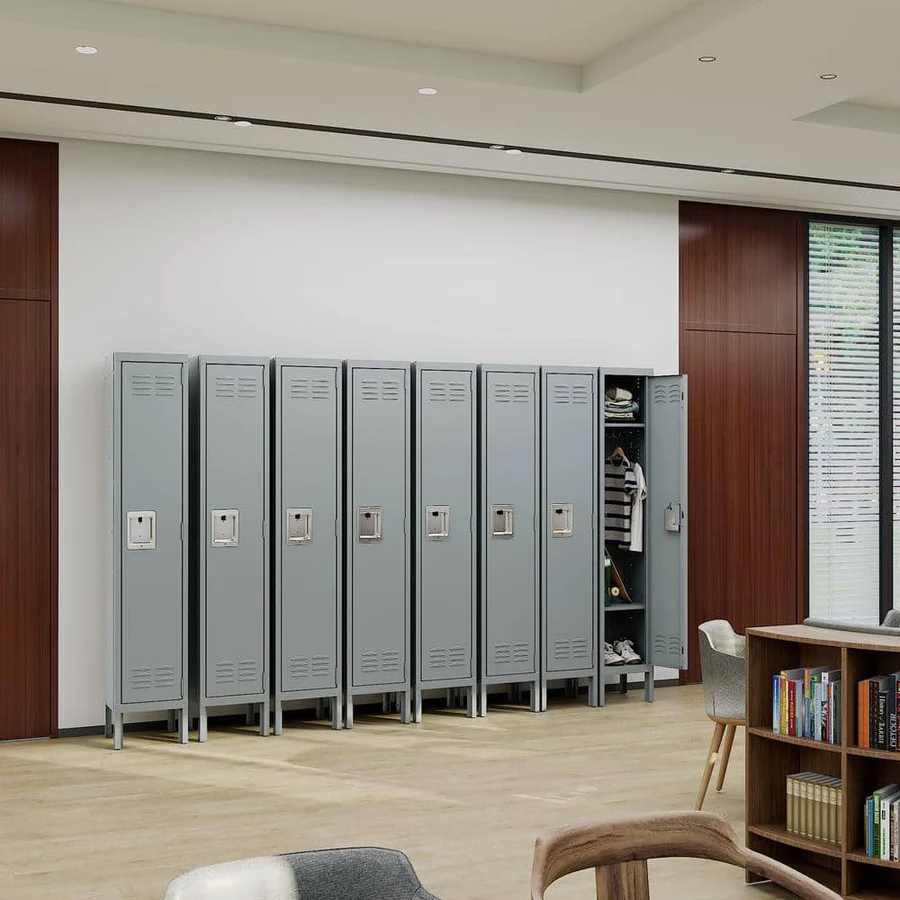
Standard tall single lockers measure 180 cm high × 45 cm wide × 50 cm deep, configured as a full-height, single-door compartment. This layout delivers one user uninterrupted vertical space—from floor to top shelf—eliminating the need for separate coat racks or stacked storage.
The 180 cm height accommodates full-length coats, uniforms, and work jackets without folding. The 45 cm width supports dense, space-efficient wall-line installations in employee changing areas, while the 50 cm depth comfortably fits work boots, helmets, and medium-sized duffels.
Ergonomics extend beyond dimensions: doors must open fully without striking adjacent units, and ventilation slots—ideally placed at both top and bottom—reduce odor and moisture buildup from damp workwear. Internal features should include a top hat shelf and a robust, accessible clothes hook or rod mounted at 145–160 cm height for universal reach.
While tall singles excel where users store bulky or hanging items, they’re over-engineered for minimal needs (e.g., phone + wallet). In those cases, compact multi-tier alternatives are more efficient. Always request dimensional drawings and confirm internal accessories—hooks, shelves, number plates—before ordering. Assumptions lead to costly fit-out errors.
How to Source Tall Single Locker Units Efficiently in B2B Channels
MOQ, Bulk Pricing, and Lead Time Optimization for Commercial Procurement
Define volume thresholds early: MOQ for premium steel tall singles typically starts at 20 units, though some suppliers accept 10–15 for pilot orders. Unit pricing ranges from $250 to $315, depending on gauge, finish, and hardware. Tiered discounts apply at higher volumes—but verify whether custom colors, upgraded locks, or reinforced hinges affect per-unit cost.
Lead time depends on three bottlenecks: steel gauge availability, powder-coating batch scheduling, and hardware supply. Standard production takes 25–40 days; customizations may add 10–15 days. Always request a written production schedule with milestone dates—including pre-shipment inspection and inland transport—and build in 7–10 buffer days for quality assurance and logistics.
Clarify Incoterms: Is pricing ex-works, FOB, or delivered? Negotiate payment terms aligned with verified capacity—e.g., 30% deposit, 70% balance against bill of lading—to mitigate supplier risk. Compare at least three suppliers using a simple matrix: unit price, MOQ, lead time, payment terms, and after-sales support (e.g., spare parts, warranty claims). This prevents hidden cost gaps and aligns procurement with installation timelines.
OEM/ODM Customization Options: Color, Hardware, Locking Systems, and Installation Readiness
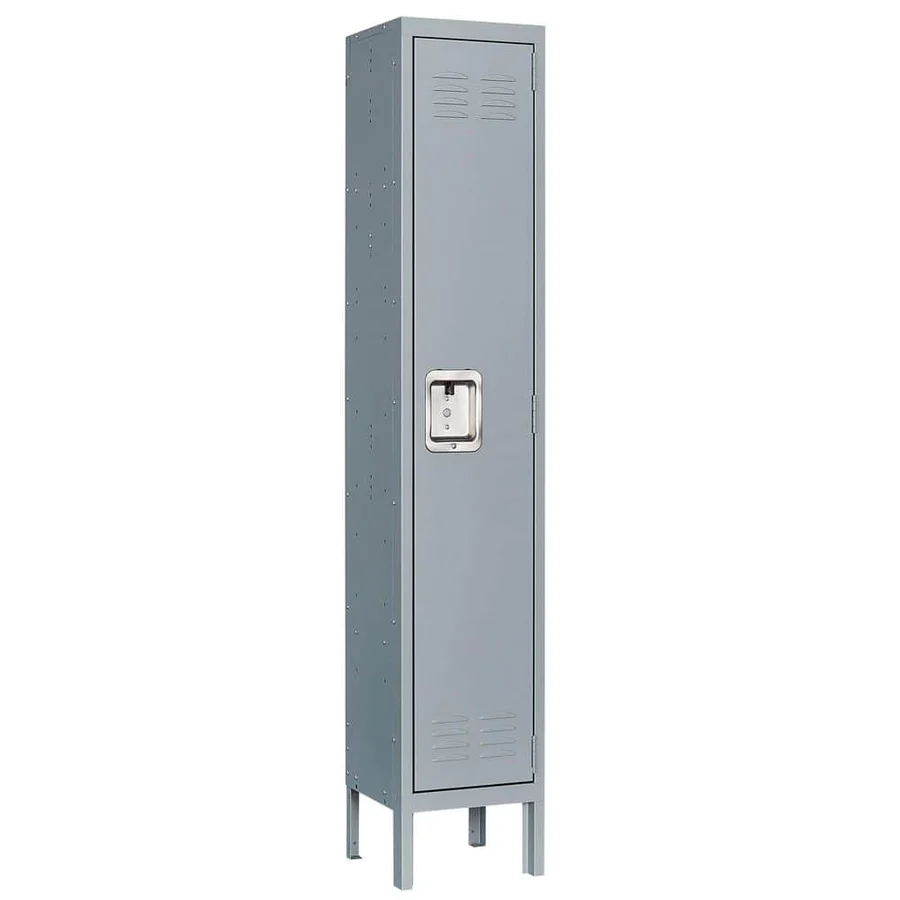
OEM and ODM programs offer meaningful control beyond off-the-shelf catalogs. Color matching to RAL or Pantone codes ensures brand consistency—provided powder coating follows proper degreasing and phosphating pretreatment.
Hardware upgrades matter: reinforced hinges, louvered vent panels, stainless steel hooks, and embossed number plates enhance durability and usability. Locking systems span mechanical cam locks and padlock hasps to smart options—RFID readers, keypad entry, or biometric modules—that integrate with existing access control platforms.
For seamless site installation, specify pre-drilled anchor holes, anti-tip brackets, and adjustable leveling feet. Clarify shipping format: fully welded units reduce on-site labor but increase freight cost and volume; knock-down kits lower shipping weight but demand skilled assembly. Always request a sample door assembly before mass production—and confirm that custom colors or electronic locks won’t delay agreed milestones. Document every hardware and finish specification in the purchase order annex to prevent ambiguity during third-party inspection.
Evaluating Reliable Steel Tall Single Locker Suppliers
Certification Essentials: ISO 9001, REACH Compliance, and Environmental Label Verification
Request current, site-specific certificates—not generic marketing claims. ISO 9001 signals a documented quality management system, but it’s only meaningful when paired with traceable batch inspection records and non-conformance logs.
REACH compliance is non-negotiable for EU-bound shipments or facilities with strict chemical stewardship policies. It covers hazardous substances in both steel coatings and plastic components (e.g., handles, vents). For schools, gyms, and healthcare sites, seek GREENGUARD Certified or equivalent indoor air quality verification—backed by VOC emissions test reports.
Ask for documentation covering three key areas:
- Powder-coat adhesion (ASTM D3359),
- Salt-spray corrosion resistance (ASTM B117),
- Chemical emissions (ANSI/UL 2818 or EN 16516).
A credible supplier shares these transparently—and can explain how each test applies to your specific locker configuration.
Factory Audit Criteria: Production Capacity, Export Track Record, and Quality Control Transparency
A rigorous factory evaluation focuses on three verifiable criteria:
-
Production capacity: Confirm monthly output for tall single lockers—and ask how the facility scales during peak cycles (e.g., Q4 retail rollouts or new gym openings). Request recent production logs showing consistent output across similar order sizes.
-
Export track record: Review references for commercial-scale projects—especially those matching your volume, geography, and finish requirements. Check on-time delivery history and post-shipment support responsiveness.
-
Quality control transparency: Observe—or request video evidence of—key checkpoints: incoming steel inspection (thickness, galvanization), weld integrity checks, pre-treatment monitoring (phosphating bath pH/timing), and final assembly sign-off. Suppliers who permit third-party audits or share QC checklists significantly reduce sourcing risk.
Critical Pitfalls to Avoid When Buying Tall Single Locker Units
Before finalizing a bulk order, treat specification as a risk-reduction exercise, not a price auction. The most common failure is selecting the lowest bid without verifying core performance attributes: steel gauge, powder-coat thickness, hinge reinforcement, or corrosion test data. Thin-gauge units may save 15–20% upfront—but dent within months in high-traffic staff rooms, triggering replacement costs that exceed initial savings.
Another recurring oversight is ignoring the full installation footprint. Tall singles need more than floor space: adequate door swing clearance (minimum 90° arc), ceiling height for top vents, wall protrusions, aisle widths for cleaning access—and even lighting placement near door handles. Overcrowding creates safety bottlenecks during shift changes and reduces long-term usability.
Key procurement pitfalls to avoid:
- Prioritizing quantity over material integrity (gauge, coating, rust protection)
- Mismatching internal layout to actual user needs—e.g., no hook for coats, insufficient depth for boots
- Selecting locking systems incompatible with existing access control infrastructure
- Accepting “standard” dimensions without validating door clearance, ergonomic reach, or ventilation alignment
- Skipping written confirmation of lead times, packaging (e.g., palletized vs. crated), or delivery site access constraints
A reliable decision weighs total lifecycle cost, environmental conditions (humidity, chemical exposure), and real-world user workflow—not just sticker price. By addressing these pitfalls upfront, B2B buyers secure performance, reduce rework, and protect long-term facility ROI.
FAQ Section
What gauge of steel should I choose for tall single lockers?
Opt for 0.8 mm gauge steel for heavy-duty performance, as it significantly enhances dent resistance and structural integrity.
What is the standard dimension for tall single lockers?
The standard dimension is 180 cm high × 45 cm wide × 50 cm deep, ideal for accommodating full-length coats and bulky gear.
How important is powder coating for steel lockers?
Powder coating is crucial as it provides durability, resists scratches and moisture, and meets EU REACH compliance for safety.
What factors should I consider when sourcing lockers for commercial use?
Consider MOQ, pricing, lead time, certifications (ISO 9001, REACH compliance), and contractual requirements like payment terms and delivery format.
Can I customize tall single lockers?
Yes, OEM/ODM programs allow customization in colors, hardware, locking systems, and installation features to meet specific needs.