
 EN
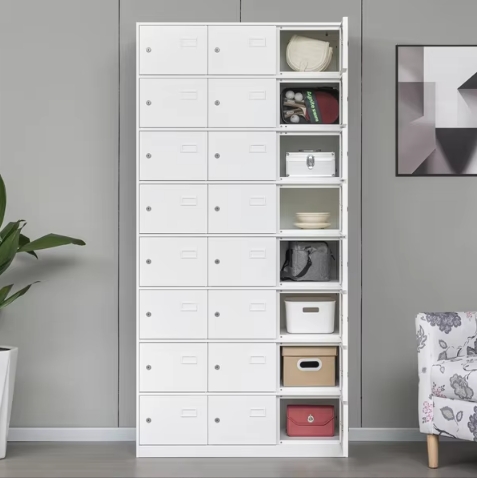
Pallets reached a school changing room just before term start, and the caretaker had one afternoon to line up double-door units along a tiled wall. Vent slots faced the corridor, hanging rails waited inside, and the floor sloped enough that some doors drifted open. On paper the order was one line item; in the corridor it became a check of which units were anchored, which shelves held a loaded bag, and which cam locks turned smoothly. Sourcing storage cupboard steel for campuses and factory cloakrooms has less to do with a catalogue code than with what survives daily handling. The notes below come from that kind of handover.
Field Notes: A Campus Changing Room Rollout
What The First Delivery Revealed
The first pallet told more than the specification sheet. Several steel storage cupboards arrived with door leaves that met cleanly at the center, while a few showed a gap wide enough to catch a finger, a sign that the hinge knuckles had been pressed slightly out of line during transport. The caretaker sorted units by swing direction before bolting anything down, then marked the ones needing a hinge adjustment.
On Site: Doors, Vents, And Rails
Double doors dominate such a rollout because a single wide leaf tends to rack when users pull it from one corner. On site, the useful checks are concrete: vent slots punched near the top and bottom to move air through damp clothing, an intermediate shelf splitting the tall bay so shoes and bags do not share one space, and a hanging rail fixed to the side panels rather than the back sheet.
Where Bulk Procurement Starts To Slip
Why Anchoring Gets Skipped On Tiled Floors
Anchoring is the item most often left until the end, and on tiled floors it is the item most often skipped entirely. A tall steel storage cupboard with a loaded top shelf behaves like a lever once someone leans on an open door, and OSHA 1910.176 treats stored material and tipping as a workplace concern rather than a cosmetic one. The observable result is a row of units that stays upright until the first busy shift, when one cabinet pulls away from the wall.
Shelf Load Ratings Buyers Commonly Miss
Shelf ratings tend to be read as a single number, yet the position of the load matters as much as its mass. A shelf rated for a stated distributed weight will bow when the same weight sits in the middle, especially on a wide bay with no front return fold. Buyers comparing storage cupboard steel units rarely ask whether the shelf has a stiffening hem or a supporting rib underneath.
How A Flat Sheet Becomes A Load-Bearing Box
Bending Reinforcement Ribs Into Door Panels
Cold-rolled steel sheet arrives flat and gains stiffness through forming, not through thickness alone. A CNC bending machine folds the door edge into a return, and a pressed rib across the inner face resists the twisting that makes a tall leaf sag at the latch side. Spot welding then ties the rib to the skin without warping the visible surface. Laser cutting and hydraulic punching produce the vent slots and lock holes before bending, so the holes stay aligned.
Thicker Gauge Versus Repeated Door Swing
Gauge is the blunt instrument of stiffness; adding sheet thickness raises cost faster than adding a well-placed fold. A thicker sheet still flexes at the hinge if the knuckle is short or the screw holes are slotted oversize, and repeated door swing works the metal at exactly that point. Pretreatment matters too. Degreasing and phosphating prepare the surface before electrostatic powder coating, and a curing oven sets the finish.
Standards, Specifications, And Buyer Checkpoints
Recognized Standards Shape The Specification
A specification holds together when it names test methods rather than adjectives. ANSI/BIFMA X5.9 sets strength and durability expectations for storage units, which is the relevant reference for shelf load and door cycle behavior. ISO 9001 describes the quality management system behind repeatable production, useful when a rollout spans several batches. OSHA 1910.176 covers material storage and tipping, while OSHA 1910.37 and NFPA 101 address exit routes and aisle width, both easy to forget when a corridor fills with cabinets. ANSI Z535.4 guides the safety labels attached to the units. Together these references turn a purchase order into something an inspector can verify.
Buying storage cupboard steel units: Set the door count, shelf positions, vent slot layout, lock type, and hanging rail in writing before requesting a quote, and ask whether the plant accepts custom orders from a drawing or a sample. A Luoyang workshop founded in 1992, with 30,000 square meters of floor space and a monthly output of 10,000 pcs, can hold a single specification across a long run. Confirm the gauge, the shelf rib detail, and the anchoring kit as line items, not as afterthoughts.
Inspecting a steel cupboard on arrival: Check that double doors meet at the center without a tapered gap, that vent slots are clean of burrs, and that the cam lock or padlock hasp turns without binding. Set one unit on a level floor and open the door halfway to see whether it drifts; a drift that grows suggests a hinge or a twist in the frame rather than a leveling problem. Compare the shelf rib and the weld pattern against the approved sample.
Using a steel storage cupboard: Distribute weight toward the shelf supports, keep the heaviest loads on lower shelves, and anchor tall units to the wall before the first full shift. Leave the vent slots unblocked so damp clothing can dry, and avoid hanging a full rail of wet coats on a door that was never braced for lateral pull. Label bays so users do not overload one cupboard while the next stays empty.
Maintaining storage cupboard steel units: Wipe the powder-coated surfaces with a mild cleaner, and touch up any chip at the hinge edge before rust can creep under the film. Re-tighten hinge screws and leveling feet at the start of each term, recheck anchors after any floor work, and cycle each lock so a stiff cam does not get forced. A short log of which bays needed adjustment turns a one-off rollout into a predictable replacement schedule.
Frequently Asked Questions
Q: What should a school specify for a changing-room steel cupboard?
A: A school should set the door count, shelf positions, vent slot placement, hanging rail, and lock type in writing before asking for a quote. The specification should also name the anchoring method and the shelf load expectation. Asking for a sample unit from the same production run lets the caretaker check door alignment and cam lock feel before the full delivery arrives, which avoids sorting problems on the day of installation.
Q: Are vent slots necessary on a steel storage cupboard?
A: Vent slots matter wherever damp clothing, sports kit, or workshop overalls are stored. Without top and bottom openings, moisture stays inside a closed steel storage cupboard and the finish along the lower seam suffers first. Slots punched before bending keep their shape and stay free of sharp burrs. For dry archive storage they are less critical, but for a changing room they are a low-cost detail that extends service life.
Q: How many shelves does a double-door unit need?
A: A double-door unit usually needs at least one intermediate shelf, with a hanging rail above it for coats and open space below for bags or footwear. Splitting the bay keeps heavy items off a single span and stops the tall door from being used as a hook point. Buyers can ask for adjustable shelf positions so the same steel cupboard serves a primary school one year and a staff cloakroom the next.
Q: Can cabinets be anchored to a tiled floor?
A: Anchoring to tile is possible, but it needs the correct fixings and, often, a backing board so the bracket does not crack the glazed surface. Where drilling is not allowed, a common approach is to link a row of units together and fix the end cabinets, which spreads a tipping load across the run. OSHA 1910.176 treats unstable storage as a hazard, so the method should be agreed before delivery.
Q: Which lock type suits shared staff storage?
A: Shared staff storage usually works with a cam lock or a padlock hasp, because keys can be reassigned and a hasp lets a user supply a personal padlock. A combination lock suits rotating shifts where key handover is awkward, while an RFID lock fits sites that already manage electronic access. The choice is less about the cylinder than about who holds the credential and how quickly it can be revoked.
Q: When should a buyer request a custom order?
A: A custom order makes sense when the room has a fixed bay width, a nonstandard height under a window, or a required color that the standard range does not carry. Plants that work from a customer drawing or a physical sample can adjust shelf positions, vent layout, and lock type before tooling begins. Requesting the change at quote stage costs less time than modifying a finished batch.