
 EN
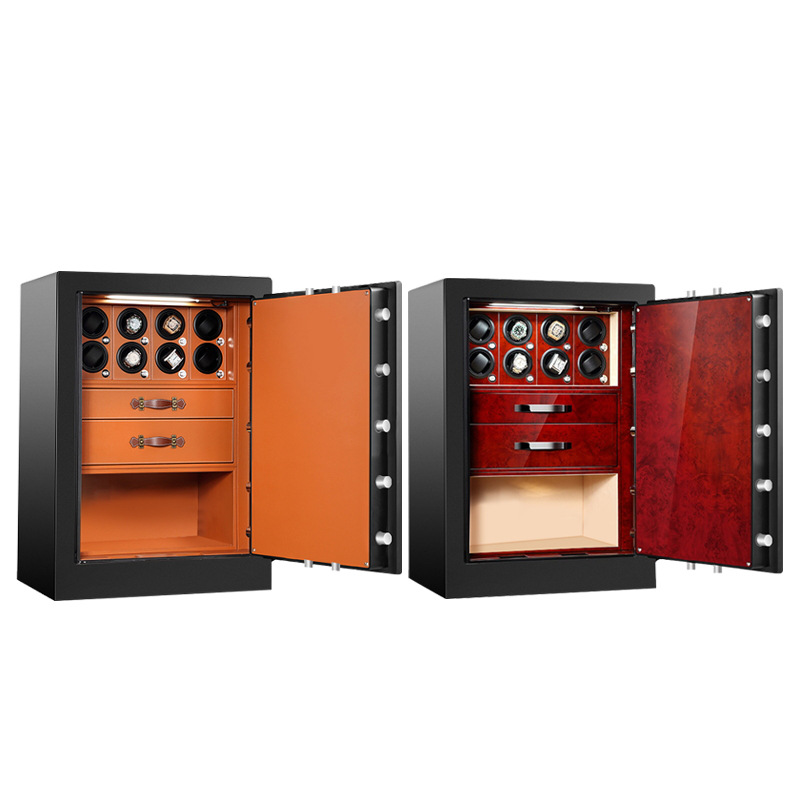
Robust Steel Construction for Fire and Impact Resistance
Cold-Rolled Steel Gauge, Tensile Strength, and Load-Bearing Integrity
A heavy-duty fireproof safe begins with a body fabricated from cold-rolled steel plate, typically in the 10–12 gauge range—equating to a thickness of 0.1046–0.1345 inches. This provides structural heft without excessive weight. Cold rolling enhances yield strength and surface hardness over hot-rolled alternatives, improving resistance to drilling, prying, and deformation. Tensile strength commonly exceeds 60,000 psi, enabling the walls to withstand bending loads during building collapse or falling debris. Impact testing shows such steel can endure strikes from airborne debris at speeds up to 100 mph—a realistic benchmark for fire scenarios involving collapsing shelves or structural fragments.
Continuous welded seams—not spot welds—distribute force evenly across corners and door frames, preserving dimensional stability under stress. Even when the outer shell heats beyond 800°F during fire exposure, the thicker cold-rolled plate slows conductive heat transfer into the interior. This combination of gauge, tensile strength, and seam integrity maintains the safe’s shape and prevents door jamming, ensuring continued protection during both thermal and mechanical threats.
Integrated Bolt-Down Systems and Anchoring Stability
Anchoring stability is what distinguishes a true heavy-duty fireproof safe from a portable lockbox. Most models include pre-drilled anchor holes in the floor panel—and often the rear wall—for secure attachment to concrete slabs or structural framing. Using ½-inch or larger concrete wedge anchors or epoxy-set bolts integrates the safe into the building envelope.
This prevents thieves from tipping the unit to gain leverage on the door—a common attack vector against freestanding safes—and eliminates the risk of complete removal. In fire or impact events, anchoring prevents shifting, sliding, or catastrophic fall-through weakened flooring. Load transfers directly from the safe body into the substrate, minimizing flex and maintaining door-frame squareness—even in taller units with high centers of gravity. Under lateral forces from debris or partial collapse, bolted connections preserve alignment so the door seal and locking bolts remain fully functional. For a fireproof safe facing combined fire, water, and structural stress, integrated anchoring transforms its mass into a stable, immovable protective unit.
Advanced Fireboard Insulation and Thermally Decoupled Wall Design
A heavy-duty fireproof safe relies on more than thick steel; its inner fireboard layers determine how much heat reaches valuables. The most effective designs pair mineral-based boards with an air gap to decouple the inner wall from the outer shell.
Vermiculite-Perlite-Gypsum Composite Performance at 1200°F
Vermiculite-perlite-gypsum composites combine exfoliated mineral particles with a gypsum binder to form low-density, high-insulation panels. When exposed to furnace temperatures near 1200°F (649°C), these panels slow heat conduction by trapping still air in microscopic voids. Thermal data show vermiculite board conductivity remains below 0.12 W/m·K at 200°C, and the material retains structural integrity above 1100°C without cracking or shrinkage. Unlike organic fiberboard, vermiculite and perlite release only trace water vapor—not flammable gases—during heating. The gypsum binder contributes bound water that absorbs substantial energy during endothermic dehydration. Together, these mechanisms significantly delay interior temperature rise, helping maintain safe internal conditions for paper, digital media, and other heat-sensitive contents.
Double-Walled Construction and Thermal Lag Effect
Double-walled construction places fireboard between outer and inner steel panels, establishing two thermal boundaries and introducing a low-conductivity air cavity. This design creates a pronounced thermal lag: as the outer wall heats, the inner wall remains cooler because heat must first saturate the insulation layer before crossing the air gap. In a 2023 fire-test comparison, double-layered boards with staggered joints reduced inner-shell temperature to 56.3°C after 40.7 minutes—versus 343.2°C in an unsealed single-layer configuration. Staggered seams eliminate direct thermal pathways, while fire-rated sealant at joints extended refractory performance to 225 minutes. This dual-boundary configuration doesn’t just insulate—it strategically delays heat ingress for critical minutes.
Heat-Activated Door Seal Technology for Complete Fire Containment
Intumescent Gasket Expansion and UL 72–Certified Sealing Integrity
The narrow gap between door and body is a critical vulnerability in any fireproof safe. Heat-activated intumescent gaskets remain inert during normal use but expand rapidly—often 5 to 20 times their original volume—when exposed to elevated temperatures. This expansion fills operational gaps, compensates for heat-induced warping, and blocks flame and hot-gas penetration. UL 72–certified sealing integrity validates this behavior under standardized furnace conditions, confirming reliable containment even as steel components shift.
Some advanced designs integrate cold smoke seals that activate before intumescent expansion begins, creating a layered barrier. This ensures internal temperatures stay below damage thresholds for paper, cash, and digital media throughout the full fire event—delivering true perimeter-level containment.
Reinforced Locking System: Bolts, Hinges, and Relocker Redundancy
Triple-Point Bolt Deployment and Warpage-Resistant Door Alignment
Triple-point bolt deployment engages hardened bolts at the top, bottom, and side of the door in a single motion. This multi-point pattern distributes prying and impact forces across the frame, dramatically reducing leverage at any single point. Heavy-duty hinges feature reinforced barrels and thicker knuckles to resist shear and bending—keeping the door leaf aligned even as temperatures rise or blunt force is applied.
Mechanical, glass, and thermal relockers add fail-safe redundancy: if the primary lock is compromised via drilling, shattering, or heating, spring-loaded or cable-driven secondary bolts engage automatically. This preserves door alignment and seal integrity under attack—ensuring the fire rating remains intact and critical contents stay protected amid combined thermal and physical stress.
Dual-Certified Structural Integrity: Fireproof Safe Performance Under Combined Threats
A dual-certified fireproof safe earns its rating only after passing sequential fire endurance and forced-entry tests that mirror real-world threat progression: first extreme heat, then physical attack. UL 72 fire testing subjects the exterior to 1,700°F while requiring interior temperatures to remain below 350°F for one hour. UL 1037 residential security testing adds a five-minute hand-tool assault on door and body. Together, these standards verify that steel gauge, fireboard insulation, heat-activated sealing, and locking mechanics function not in isolation—but as a unified load path.
| Certification focus | Test stress | Structural demand |
|---|---|---|
| Fire endurance (UL 72) | Exterior 1,700°F, interior ≤ 350°F | Insulation, seal expansion, door alignment |
| Burglary resistance (UL 1037) | 5-minute hand-tool attack | Bolt deployment, hinge strength, relocker redundancy |
Dual certification validates performance under the most realistic failure sequence: fire first, then impact or prying, then cooling and attempted re-entry. A safe designed solely for fire may lose locking alignment as metal softens and warps; one built only for burglary resistance may fail thermal containment. Only integrated engineering—verified through dual certification—ensures comprehensive protection.
FAQs
What is the main benefit of using cold-rolled steel for fireproof safes?
Cold-rolled steel offers enhanced yield strength, surface hardness, and tensile strength compared to hot-rolled alternatives, providing greater resistance to drilling, prying, deformation, and other mechanical stresses during extreme conditions.
Why is a bolt-down system essential for fireproof safes?
A bolt-down system prevents thieves from tipping or removing the safe and ensures the unit remains stable during fire, impact, or structural collapse events, maintaining door-frame alignment and protective capabilities.
What is the function of fireboard insulation in a fireproof safe?
Fireboard insulation, especially mineral-based composites like vermiculite-perlite-gypsum, reduces heat transfer, delays temperature rise inside the safe, and protects its contents during high-heat scenarios.
How do intumescent gaskets enhance fire containment?
Intumescent gaskets expand when exposed to heat, filling gaps between the door and body to block flames and prevent hot gasses from entering the safe, ensuring internal temperature control throughout fire exposure.
Why is dual certification important for fireproof safes?
Dual certification ensures that the safe can withstand both fire and physical attacks under rigorous testing conditions, verifying its ability to perform under realistic threats such as heat, impact, and burglary attempts.
Table of Contents
- Robust Steel Construction for Fire and Impact Resistance
- Advanced Fireboard Insulation and Thermally Decoupled Wall Design
- Heat-Activated Door Seal Technology for Complete Fire Containment
- Reinforced Locking System: Bolts, Hinges, and Relocker Redundancy
- Dual-Certified Structural Integrity: Fireproof Safe Performance Under Combined Threats
-
FAQs
- What is the main benefit of using cold-rolled steel for fireproof safes?
- Why is a bolt-down system essential for fireproof safes?
- What is the function of fireboard insulation in a fireproof safe?
- How do intumescent gaskets enhance fire containment?
- Why is dual certification important for fireproof safes?